
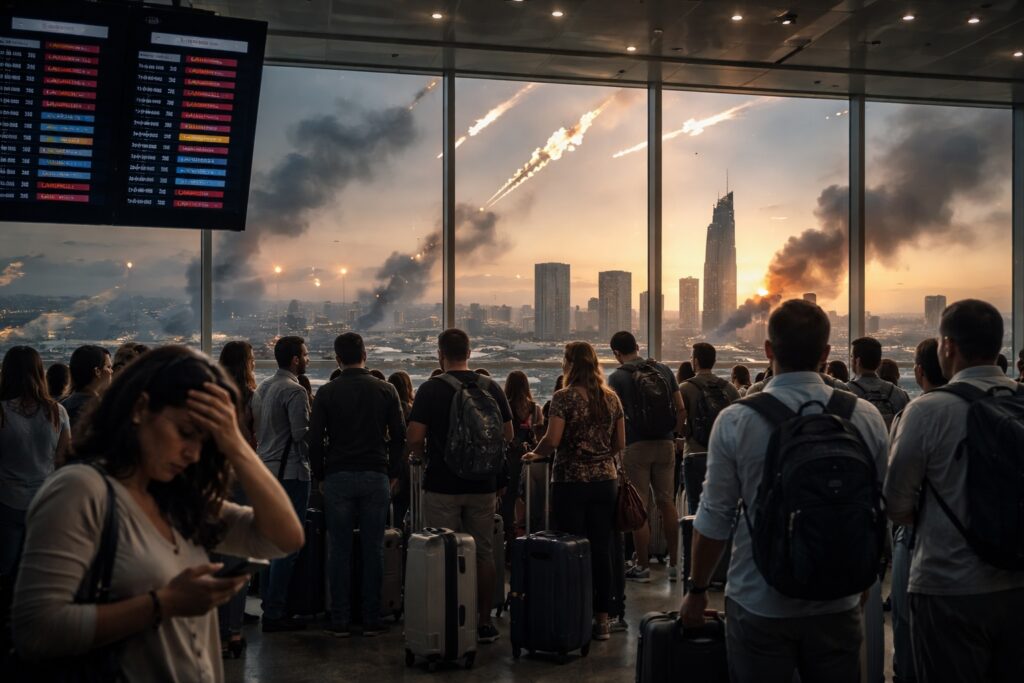
At the end of February, a new military escalation in the Middle East once again shook a region that had already been marked for months by geopolitical tensions. After several days of rising tension between Iran, the United States, and Israel, the situation eventually led to attacks and military responses that triggered a rapid international reaction.
Beyond the political and legal debate —which for many analysts raises serious questions about international law and the sovereignty of states— the reality is that thousands of people found themselves trapped in the middle of a conflict that was not theirs.
One of the immediate consequences was the impact on international air travel. Airspace began to experience restrictions, mass flight cancellations, and route changes.
We were there when it all happened.
What was supposed to be a simple return to Europe turned into six days of cancellations, uncertainty, explosions in the city, and a desperate struggle to find a flight home.
A normal trip that turned into an unexpected situation
Our trip to the United Arab Emirates had gone completely normally. We spent four days in Dubai and then travelled to Abu Dhabi, where we planned to spend three more days before returning to Europe.
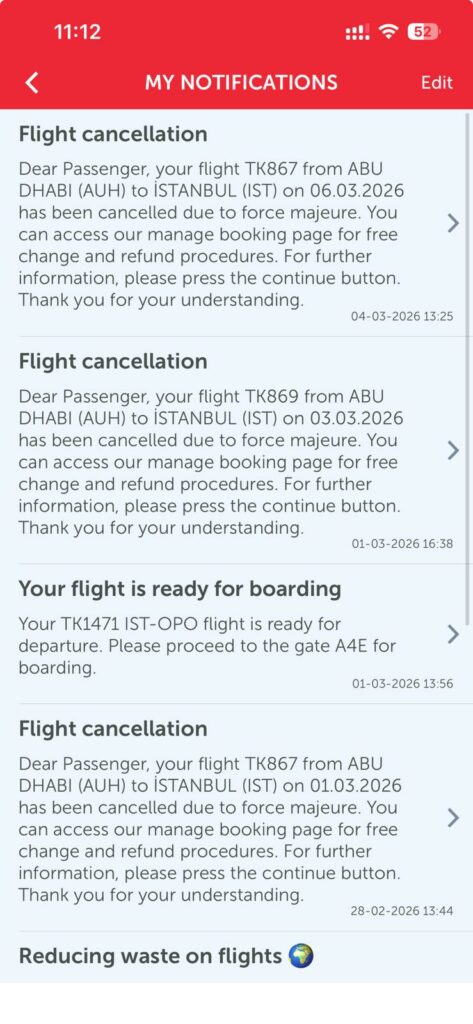
Our return flight was scheduled for March 1st, with a stopover in Istanbul. But on February 28th we received an email from Turkish Airlines informing us that the flight had been cancelled. The message instructed us to enter the airline’s application to try to rebook it.
When we opened the app, we discovered that the closest available date was March 3rd. That meant staying two additional nights in Abu Dhabi.
Extending our stay before we were left without a room
After rebooking the flight, we ran to the hotel reception to extend our stay. We were afraid that, with the situation in the region beginning to escalate, the hotel might run out of available rooms.
At that moment we noticed something that caught our attention. When checking Booking.com, we saw that the price per night at the hotel had doubled compared to what we had originally paid.
Given the situation, we decided to secure the room as quickly as possible. Instead of the all-inclusive plan we originally had, we opted for full board, which was slightly cheaper.
We tried to stay calm. We thought that in two days we would be able to leave the country.
Trying to contact the airline
We tried to speak with Turkish Airlines to understand what was happening. We called several customer service centers, including the headquarters in Turkey and other international offices. The responses were always the same: no one had clear information.
In theory, when an airline cancels a flight it should cover several passenger expenses, such as: accommodation, meals, transportation, assistance.
But in this case the answer was always ambiguous. Due to the conflict situation, they said they could not confirm which expenses the airline would cover or how the situation would be managed.
The second cancellation
Shortly afterward came another cancellation by Turkish Airlines. We entered the application again and managed to rebook the flight, this time for March 6th.
That was when we discovered something unexpected. There was an announcement from the Ministry of Culture and Tourism, issued on February 28th, stating that the government would cover accommodation expenses for tourists affected by flight cancellations due to the conflict.
The hotel had known about that announcement since February 28th, but no one had informed us, and by then we had already paid two additional nights out of our own pocket.
When we spoke with the hotel, they asked us to send several documents to process the extension covered by the Ministry of Culture and Tourism. However, responses took a long time to arrive and the information was confusing.
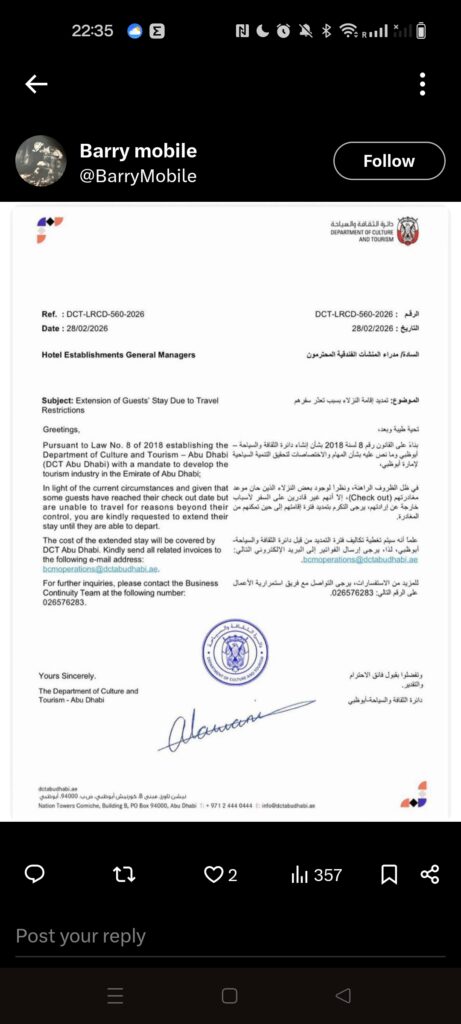
When we requested to extend our stay at the hotel after the second flight cancellation, we were told that according to the Ministry of Culture and Tourism, only two nights of accommodation would be covered and only the room, without meals. That seemed completely illogical to us. If the Ministry was extending the stay of tourists affected by the cancellations, it made sense that it should be done under the same conditions as the original reservation.
In our case, we had booked a full board stay, so we understood that any extension should maintain those same conditions. Furthermore, it made no sense to limit the assistance to two nights if the flight problem had not yet been resolved. If we needed three additional nights until the flight departed, then those three nights should logically be covered. After several complaints and emails explaining the situation, the reception desk finally called us to say that as a courtesy, they would extend three nights with full board.
This left us with a bitter feeling. It seemed that the hotel was initially trying to offer the absolute minimum, hoping that many guests would accept it without complaining. Those who insisted or protested eventually received what they were entitled to. In the middle of an already stressful situation —not knowing when we would be able to return home— we also had to spend time and energy managing these claims and trying to ensure that our situation was not taken advantage of.
Meanwhile, when checking the hotel prices again on Booking.com, we discovered something even more surprising: prices had tripled.
The third cancellation
When we thought we would at least be able to leave on March 6th, Turkish Airlines cancelled the flight again. When checking the application, we discovered that the only available option was to rebook the flight for March 10th. That meant a delay of nine days compared to our original flight.
At that point we were completely desperate.
Trying to leave with Emirates
Looking at the situation, it seemed that Emirates and Etihad were the only airlines still operating flights with relative normality.
So, we decided to buy a flight with Emirates to Lisbon, departing from Dubai. We paid approximately €1,500 for two tickets. But just a few hours later, the flight was cancelled.
Trying to contact customer service was impossible. In a WhatsApp group of affected travelers, someone said they had to call 471 times before getting a response.
We went directly to an airline office. There they explained that due to the situation nothing could be done online anymore: no rebooking flights, no check-in, no transportation arrangements to Dubai.
Even the bus connecting Abu Dhabi with Dubai had been suspended.
Eventually they rebooked the flight for March 9th.
A third attempt: Etihad
In the middle of the desperation, we decided to buy another flight, this time with Etihad, with destination Rome. It cost around €2,500 for two people.
But during the night of March 5th, that flight was also cancelled.
That day was probably the worst of the entire trip because the hotel informed us they could only extend the stay until March 9th, since after that date the Ministry of Culture and Tourism would no longer cover any expenses.
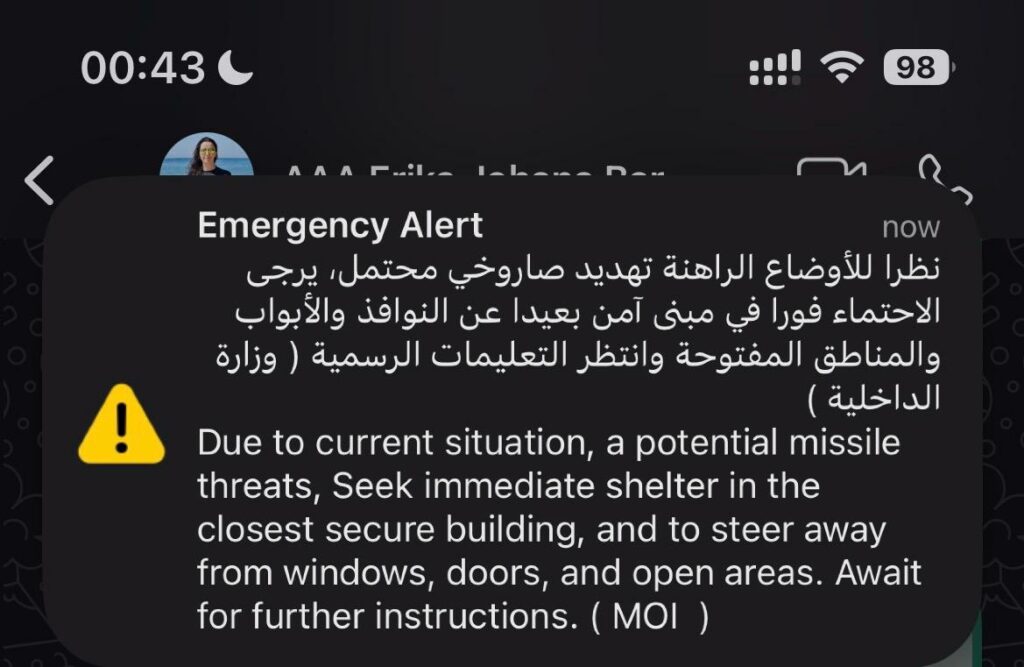
That same night missiles were raining down, and detonations were heard more intensely than ever.
The early morning of March 6th
At 4 a.m. on March 6th, while checking flight options once again, we found a possibility: a flight from Abu Dhabi to Madrid. The price was almost €4,800 for two people in economy class.
Under normal circumstances we would never have paid such an amount.
But after days of flight cancellations and no guarantee of getting out, we decided to buy it. We were able to check in online without any problem.
Explosions even at the airport
Even at the airport the tension was constant. While we were waiting in line to board, detonations were heard, and we had to run for cover.
At that moment I was completely desperate. I didn’t feel calm until the plane had been in the air for more than an hour.
Curiously, I never feared something happening to us on the ground, but I did have one very specific fear: that a missile might hit the aircraft during takeoff or during the flight.
Experiencing a conflict from the inside
During those days, detonations could be heard daily in the city. On several occasions we saw missiles being intercepted in the sky.
On the very first day we even saw one intercepted in front of the beach near our hotel.
When money becomes the only way out
One of the hardest parts of this experience was realizing how, in situations like this, everything ultimately depends on money. We were able to pay for that flight because we had savings. But many people cannot.
As the days passed: hotel prices increased, flight prices skyrocketed, available options kept shrinking.
We even saw testimonies on social media of people talking about economy flights costing up to €10,000.
The emotional impact afterward
When we finally returned to Europe, the impact of everything we had experienced was still very present. For days we had lived with fear, uncertainty, and the constant feeling of not knowing when we would be able to return home.
We had completely lost the desire to travel.
We had another trip planned —24 days in the United States— but after everything that happened, the only thing we wanted was to cancel everything and stay home.
When the world goes through such unstable moments, you begin to realize how fragile something as simple as returning home after a vacation can be.
Final reflection: what it really means to be stranded in an international crisis
After living through an experience like this, one of the clearest conclusions is that as a traveler you must be very aware of something that is rarely said clearly: in an international crisis, you are on your own.
Travel insurance usually does not cover situations related to armed conflicts or geopolitical crises. Embassies generally cannot do much more than issue recommendations or provide information. In practice, that means if you are stranded in a situation like this, you will have to cover the expenses yourself.
What happened in the United Arab Emirates was somewhat exceptional. The fact that the Ministry of Culture and Tourism covered part of the accommodation costs for tourists was highly unusual. In many other countries, travelers ended up paying everything out of their own pockets.
And that’s not all. In these situations, prices rise dramatically. Hotels raise their rates, flights skyrocket, and options become increasingly limited. In our case we ended up paying almost €5,000 for a one-way economy ticket, a price that would normally be unthinkable.
But even paying those kinds of prices does not guarantee that you will get home.
During those days we spoke with a German traveler staying at our hotel. He explained that Germany was organizing repatriation flights, but some people were still not being included. The most surprising part was that those flights departed with empty seats, something difficult to understand in an emergency situation.
On our Etihad flight, there were also many empty seats, which raised even more questions. When thousands of people are trying to leave the country, it is hard to understand why all available flights are not completely full.
The impression was that priority was not given to those who had been waiting for days, but rather to those who could pay more money for a last-minute ticket.
If there is one thing we learned from this experience, it is that travel today is no longer just about having enough money for a vacation. It also means being prepared for the possibility —however remote it may seem— that something completely outside your control might happen.
If that happens, you must assume that you will have to solve it yourself, pay exorbitant prices, and face a situation for which no one prepares you when you buy a plane ticket.
More articles on the conflict in the Middle East: