
Hello everyone,
To understand Abu Dhabi, we first need to look at its recent history.
Until the mid-20th century, Abu Dhabi was a small coastal settlement inhabited mainly by fishermen, traders, and pearl divers. For centuries, the local economy depended on fishing, maritime trade, and the pearl industry in the Persian Gulf.
Everything changed in 1958, when significant oil reserves were discovered in the emirate. This discovery completely transformed the region. Oil revenues financed major urban development, infrastructure, and modernization projects that turned Abu Dhabi into an entirely new city in just a few decades.
In 1971, with the creation of the United Arab Emirates, Abu Dhabi became the capital of the new country under the leadership of Sheikh Zayed bin Sultan Al Nahyan, the founder and first president of the state.
Since then, the city has developed a somewhat different model from Dubai: less focused on mass tourism and more oriented toward the country’s political administration, monumental architecture, and cultural projects.
Itinerary in Abu Dhabi
26 February – Qasr Al Watan
27 February – Mamsha Al Saadiyat, Louvre Abu Dhabi
1 March – Sheikh Zayed Grand Mosque
Qasr Al Watan
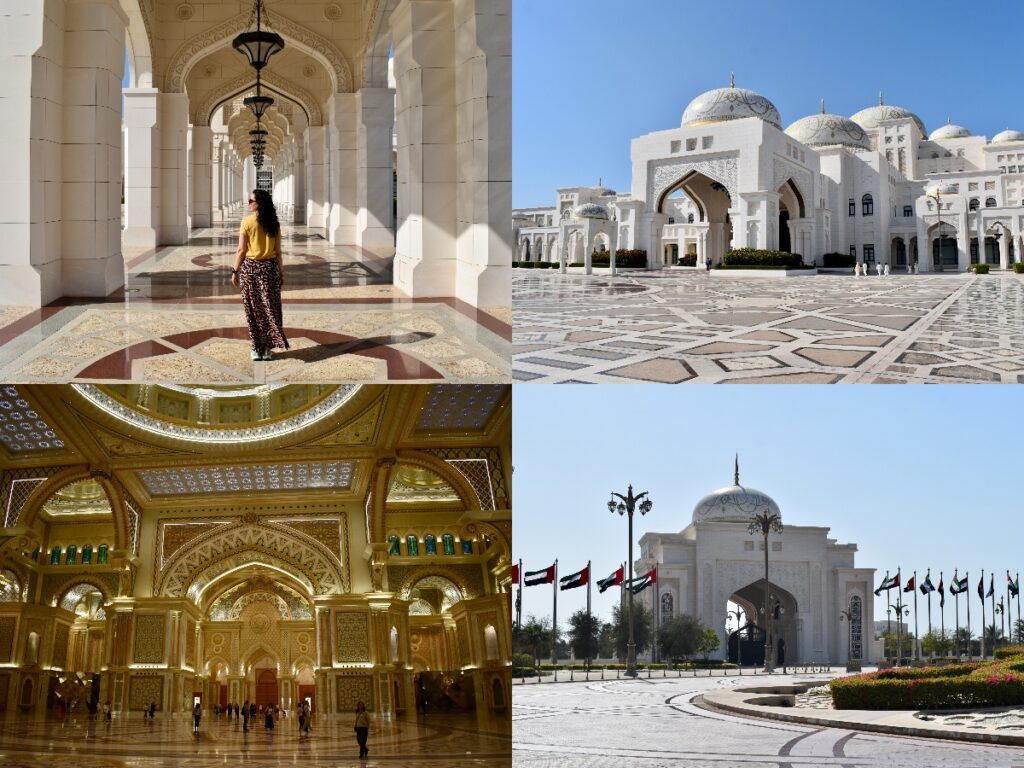
The first visit in Abu Dhabi was Qasr Al Watan, the presidential palace open to the public.
This monumental complex opened in 2019 and is part of the country’s efforts to showcase its political system, institutional history, and cultural vision. Although it is still used by the government, a large part of the complex can be visited.
The palace stands out for its enormous scale: vast marble halls, monumental domes, and geometric decoration inspired by traditional Arab architecture.
More than a historical palace in the European sense, Qasr Al Watan is a modern construction designed to symbolize the institutional power of the Emirati state.
The visit allows you to explore several ceremonial halls, exhibitions about how the government works, and a library dedicated to the history and culture of the Arab world.
Architecturally, it is an impressive place, very carefully designed and clearly conceived as a symbol of the country.
Something that caught our attention was that in this first mosque the dress code rules were less strict. Women were only required to cover their legs. Men were not required to follow any specific dress code either.
Mamsha Al Saadiyat
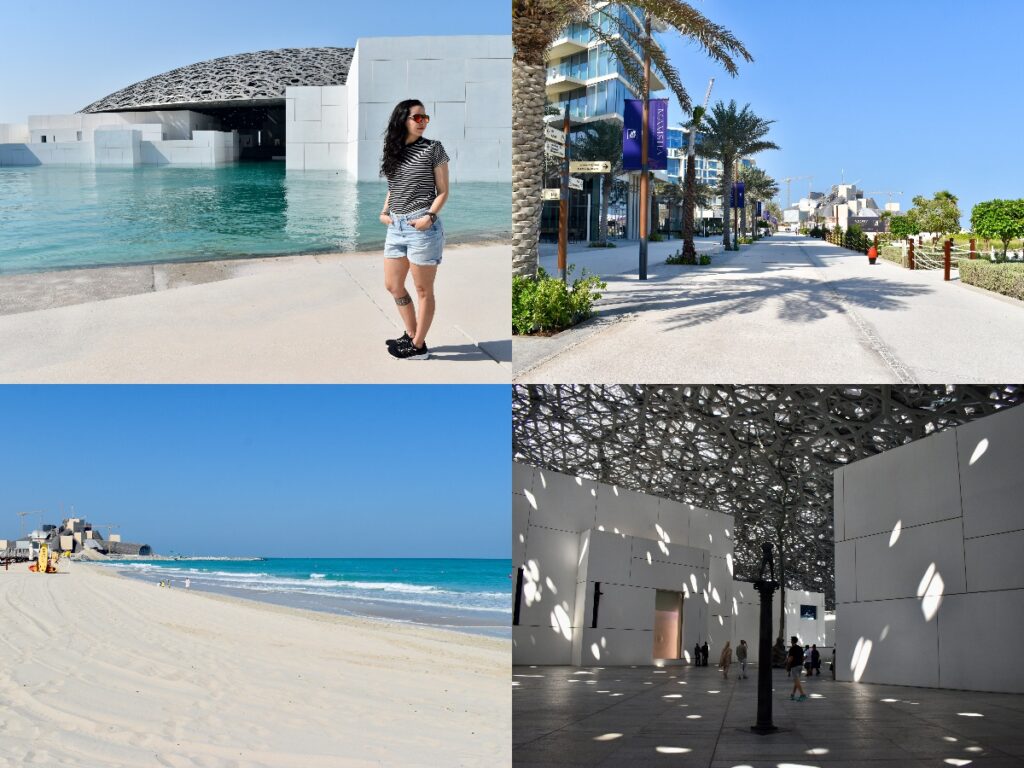
On the second day we explored Saadiyat Island, an artificial island that Abu Dhabi is developing as its major cultural and tourism district. The first stop was Mamsha Al Saadiyat, a coastal area with white sand and very clear waters. However, the experience was disappointing.
Much of the surrounding area was still under construction, something quite common in the United Arab Emirates. In addition, the beaches in the area are private.
As soon as we stepped onto the sand to take a photo, security guards appeared telling us we could not stay there without paying the entrance fee. If we wanted to access the beach or take photos with a camera, we had to pay.
This type of situation reflects a very visible trend in the country: many privileged spaces are highly privatized and mainly oriented toward high-income tourism.
One positive aspect that caught our attention was tobacco regulation. In public areas and beaches smoking is not allowed.
Louvre Abu Dhabi
After the beach, we walked to the nearby Louvre Abu Dhabi, one of the most ambitious cultural projects in the region. The museum opened in 2017 thanks to an agreement between the United Arab Emirates and France that allows the use of the Louvre name and the organization of exhibitions with works from French museums.
The building was designed by French architect Jean Nouvel and stands out for its enormous metallic dome measuring 180 meters in diameter.
The structure is made up of thousands of geometric patterns that allow light to pass through, creating an effect known as the “rain of light”, inspired by traditional Arab architectural latticework. The architecture is truly spectacular and makes the museum one of the most photographed places in Abu Dhabi.
The permanent collection is not huge, but it is interesting enough for a visit of a few hours.
When we visited, there was also a temporary exhibition of Picasso, which made the ticket well worth the price.
In addition, the entrance fee is not excessively expensive compared with other major international museums. That said, the museum is crowded.
Many people go there only to take photos in the most famous areas of the building. In fact, it was curious to see women very dressed up —makeup, elegant dresses, or even high heels— clearly prepared to take photos on the famous walkway by the water.
At times it felt like many people were not there to visit the museum but simply to get the perfect photo for social media.
Sheikh Zayed Grand Mosque
The final major visit was the Sheikh Zayed Grand Mosque, probably the most emblematic building in Abu Dhabi.
Initially we planned to visit it on February 28, but that day a real logistical nightmare began: our flight was cancelled and a chain of problems related to the regional conflict started.
In the end, we managed to reorganize the plan and visited it on March 1.
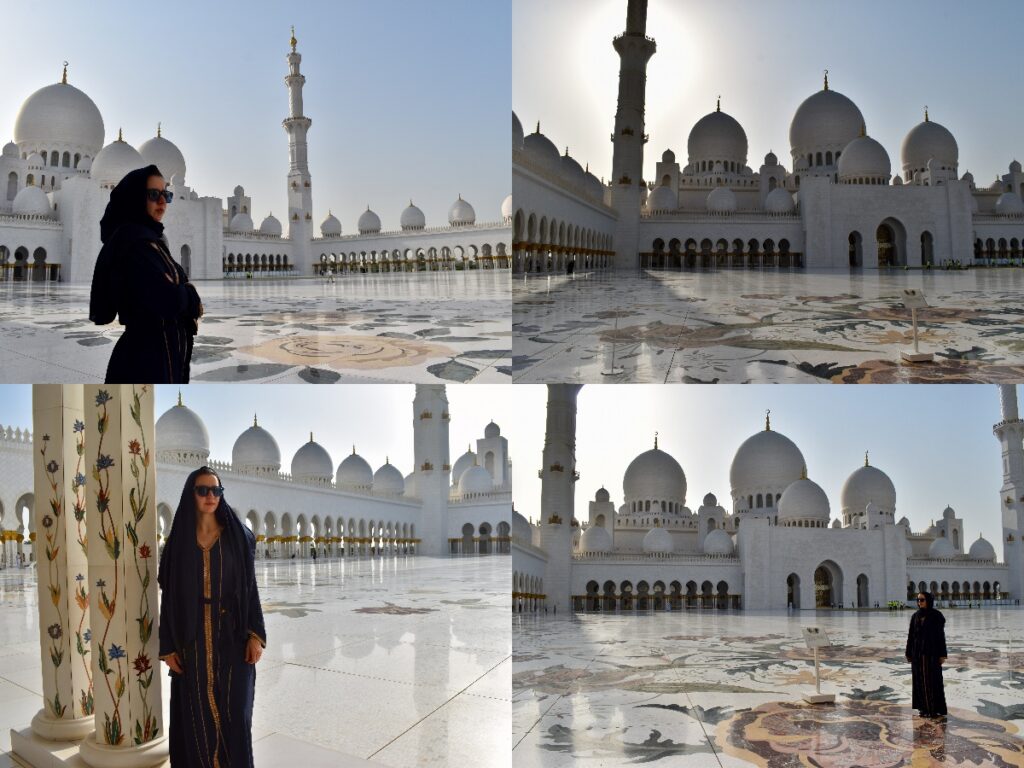
The mosque was inaugurated in 2007 and is named after Sheikh Zayed bin Sultan Al Nahyan, founder of the United Arab Emirates. It is one of the largest Islamic temples in the world and can host more than 40,000 worshippers.
Among its most impressive features are more than 80 domes, four minarets over 100 meters tall, the largest hand-woven carpet in the world, and enormous chandeliers decorated with Swarovski crystals.
Unlike other mosques we had visited, the dress code rules here were strict. Women had to completely cover their arms, legs, and head. In fact, we saw several people who were not allowed to enter because they did not fully comply with these rules.
In my case, I decided to buy an abaya and cover my hair with a scarf. For men the rules were somewhat more relaxed, although they also had to wear long pants and cover their arms.
The visit is free and the building is truly spectacular.
One curious detail is that to reach the main entrance you must walk through an underground shopping mall full of shops and cafés. This is striking because even access to a religious place involves passing through an area designed for consumption. It is a small example of how present shopping malls are in every space in the country.
Abu Dhabi vs Dubai
Overall, we liked Abu Dhabi more than Dubai. If I had to choose a place to live in the United Arab Emirates, it would probably be Abu Dhabi. The city feels more livable and somewhat more balanced.
It has pleasant urban spaces such as the Corniche waterfront promenade, where you can walk or cycle for kilometers along the sea. There are also beautiful public beaches, such as Corniche Beach.
In general, the city is very clean, and some areas are accessible on foot. The hotel where we stayed in Abu Dhabi was better located than the one we had chosen in Dubai, which made it much easier to move around by walking.
In addition, Abu Dhabi seems to have some cultural content. Between monumental mosques, museums, and certain urban spaces, the city offers something more than just shopping malls.
Dubai, on the other hand, is built almost entirely around shopping malls and attractions designed to break records or take photos.
The conflict and the unexpected increase in travel costs
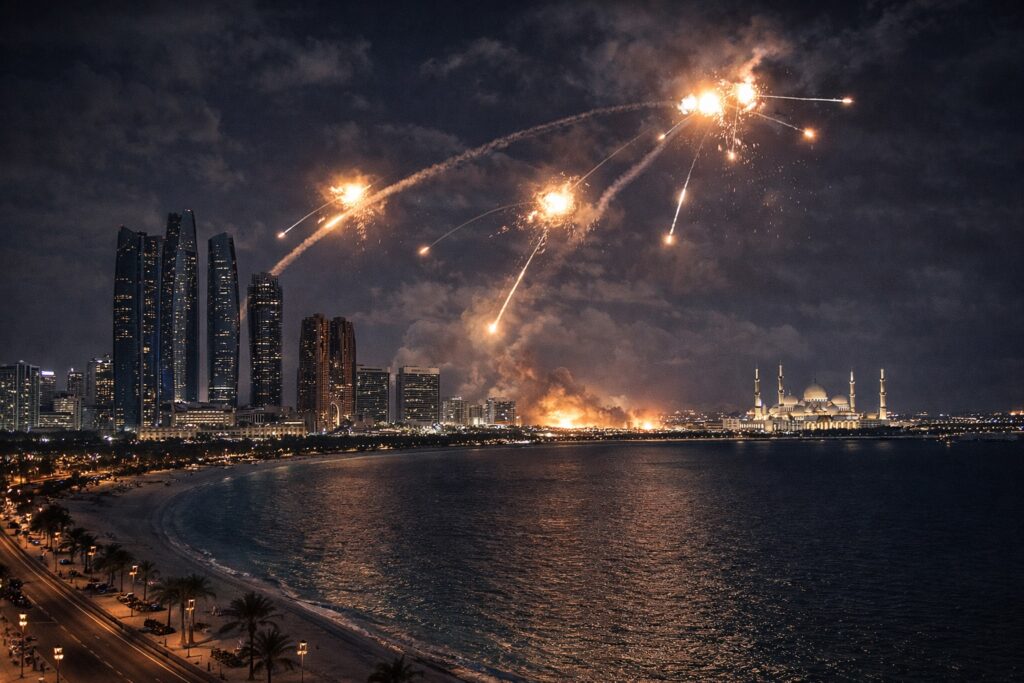
The initial plan was to return on March 1. However, the regional conflict that began at that time caused cancellations and great uncertainty in air traffic. From that moment on, a real odyssey began to try to leave the country.
The original flight with Turkish Airlines offered no clear solution. We then tried to buy another flight with Emirates. Since that one was not confirmed either, we bought another with Etihad. That flight was also cancelled. Finally, we had to buy a second flight with Etihad to leave the country.
In total, we ended up buying four different flights to return.
The situation was extremely stressful and turned the trip into a very different experience from what we had planned.
Total travel expenses
Due to the cancellations and the unexpected extension of the trip until March 6, the final budget ended up being much higher than expected.
Flights: €6,773.6
Accommodation: €2,906.7
Transport: €309
Supermarkets: €286.4
Visits: €67.3
Other expenses: €31.4
Total trip cost: €10,374.7
Here is the link to my YouTube channel:
More about the trip to the United Arab Emirates: