
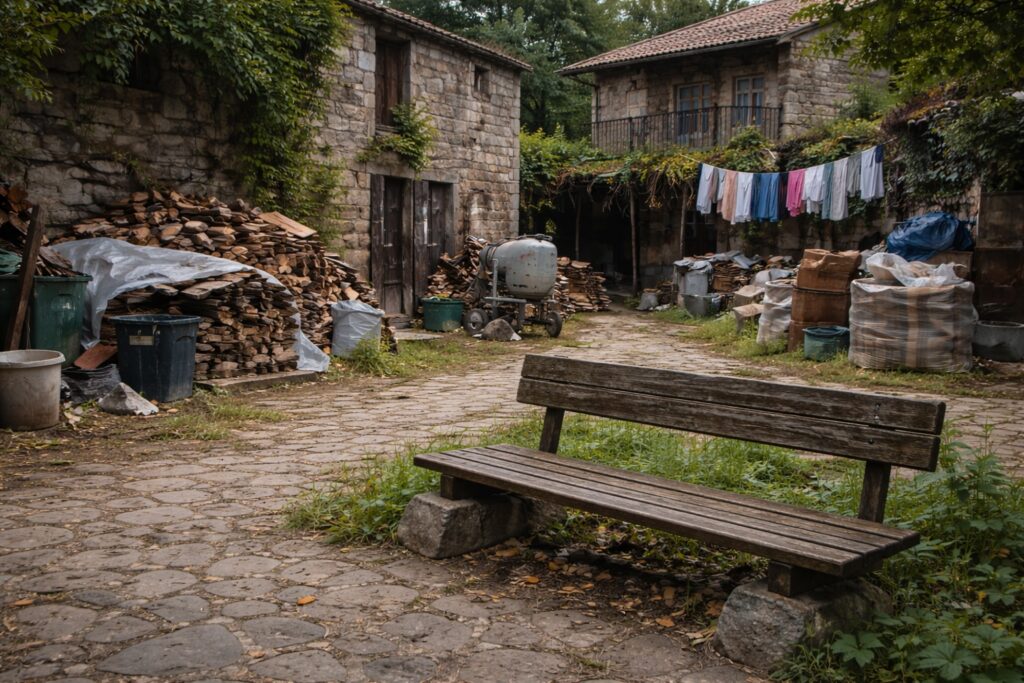
Over the past few months, I have been sharing on this blog the different complaints we have filed with the Cenlle City Council since we bought our house. In three previous posts, I described in detail problems related to the condition of the roads, the neglect of public spaces, the lack of maintenance of basic elements such as benches or fountains, and a municipal management that, in practice, seems non-existent.
This is not an isolated complaint or a one-off incident. It is an accumulation of formal complaints that, far from being resolved, have continued to pile up without any response.
At the beginning of February 2026, none of the complaints submitted had been resolved. In all cases, the legally established three-month period had elapsed without any reply, which forced us to file appeals due to administrative silence. At the same time, we had to turn to the Valedor do Pobo of Galicia to try to obtain, at the very least, some kind of reaction from the City Council.
The pattern was always the same: they do not answer phone calls, they do not answer emails, they do not answer complaints. An absolute administrative absence.
Changing promises and deadlines that are never met
When they were finally forced to respond, the replies did not bring real solutions, but excuses and deadlines that were constantly extended.
In one of the first responses, they assured us that before the end of 2025 the entire street would be resurfaced. The year ended and absolutely nothing happened. Later on, when we complained about the danger posed by some badly placed public benches —unstable, resting on stones and not anchored to the ground— they replied that “when the road was repaired,” the benches would also be properly installed. On that occasion, the new deadline was already set between January and February 2026.
Regarding the village fountain, which was completely abandoned, the response was even more revealing: the Concello claimed to have had an approved grant for its repair for approximately two years. At the beginning of February 2026, years later, the fountain was still the same.
The most serious case: the illegal discharge of rainwater
But among all the complaints, there was one that was clearly the most important and urgent from the very beginning.
Our terrace receives the direct discharge of rainwater from a roof that has no gutter. Something that is already illegal in itself. Over time, we also discovered that a second house was discharging its rainwater onto that same roof, meaning that the water from two different roofs ended up falling directly onto our terrace.
The Land Law of Galicia is clear in these cases: the town council has the obligation to intervene, require the responsible owners to fix the problem and, if they do not do so, carry out the work subsidiarily and later charge the cost to the offending owners.
Despite this, the Cenlle City Council did not respond within the legal deadlines, did not act and provided no solution. Once again, we had to file an appeal and escalate the complaint to the Valedor do Pobo of Galicia so that the town council would simply do its job.
Silence even before the Valedor do Pobo
The response from the Valedor do Pobo was particularly telling. We were informed that they were resending the document to the Cenlle City Council because the deadline had passed and the town council had not replied.
In other words, it was no longer just a matter of ignoring citizens, but of not responding even to an official body whose role is to supervise the actions of public administrations. Administrative silence had turned into institutional silence.
A context that explains everything
As if all the above were not enough, at the end of 2025 we learned that the Cenlle City Council was involved in a case of alleged corruption related to the management of public funds over many years, reported by the opposition before the courts.
Confirmation came in February 2026, when we returned to the house in Ourense and found this official communication from the BNG of Cenlle. It stated that the City Council had been fined the largest penalty in its history, close to half a million euros, for failing to pay the water levy to Augas de Galicia and TRAGSA for more than a decade.
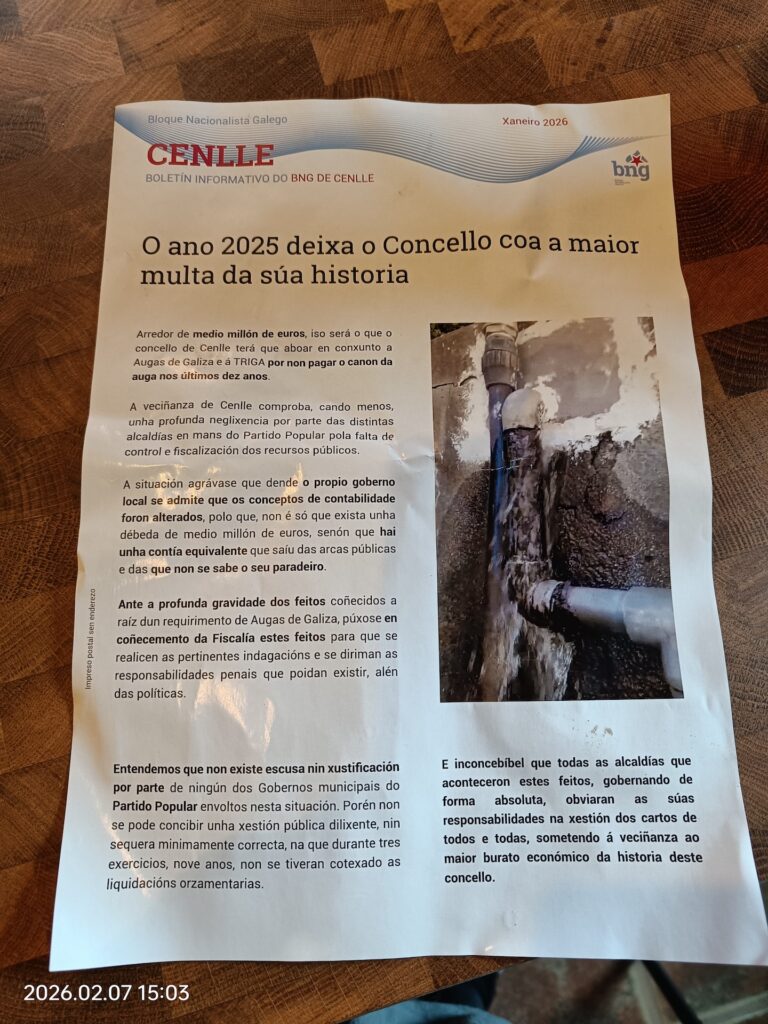
The statement itself referred to serious negligence, lack of oversight, accounting irregularities and a historic economic loss for local residents. Public money whose destination, according to the document, was not even clear.
This context does not justify anything, but it does help to explain many things. It helps explain why complaints go unanswered, why deadlines are missed, why works are promised but never carried out, and why the constant feeling is that of an absent town council or one incapable of fulfilling its most basic obligations.
April 2026: an unprecedented chain of complaints
Far from any improvement taking place, April 2026 marked a point of maximum tension in this situation.
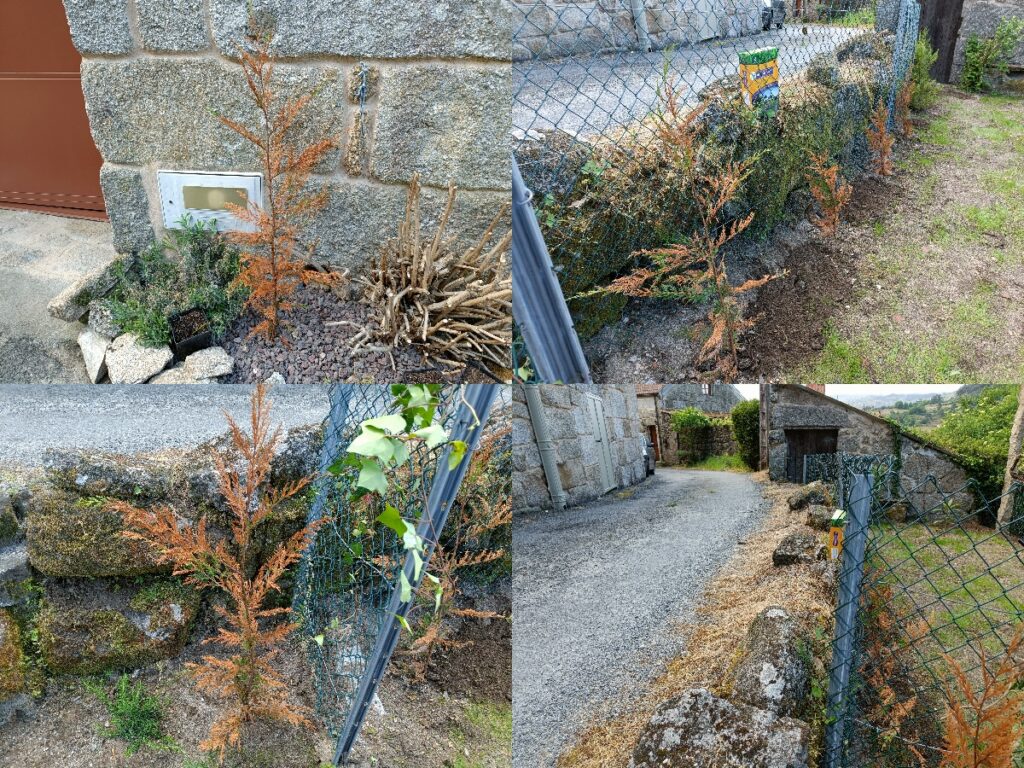
At the end of March, we had prepared one of our plots, planting cypress trees, rose bushes, and other species. However, when we returned to the property between April 11 and 12, we found that a large part of the plants had died suddenly and abnormally. As stated in the formal complaint, the damage mainly affected areas bordering the public road, while plants located in protected areas remained intact, pointing to an external and deliberate action consistent with the application of herbicide.
Given the seriousness of the events, on April 14 we filed a formal complaint with the Guardia Civil, requesting the opening of an investigation, the identification of those responsible, and the adoption of measures to prevent recurrence.
At the same time, that same month we received a new communication from the Valedor do Pobo, confirming that the Cenlle City Council had still not responded to its requests, forcing the institution to reiterate them once again, reminding the administration of its legal duty to cooperate.
On April 15, we again reported the occupation of the public square to the Guardia Civil and the Xunta de Galicia, after months of municipal inaction, despite the existence of a prior appeal for reconsideration due to administrative silence. That same day, we issued an ultimatum to the Cenlle City Council, warning that in the absence of a response, we would initiate contentious-administrative legal proceedings before the courts.
We also filed a new appeal for reconsideration regarding the rainwater drainage issue, which remains unresolved after nearly a year of complaints. The discharge originates from several properties and causes dampness, structural leaks, pavement deterioration, and safety risks, with no administrative intervention having taken place.
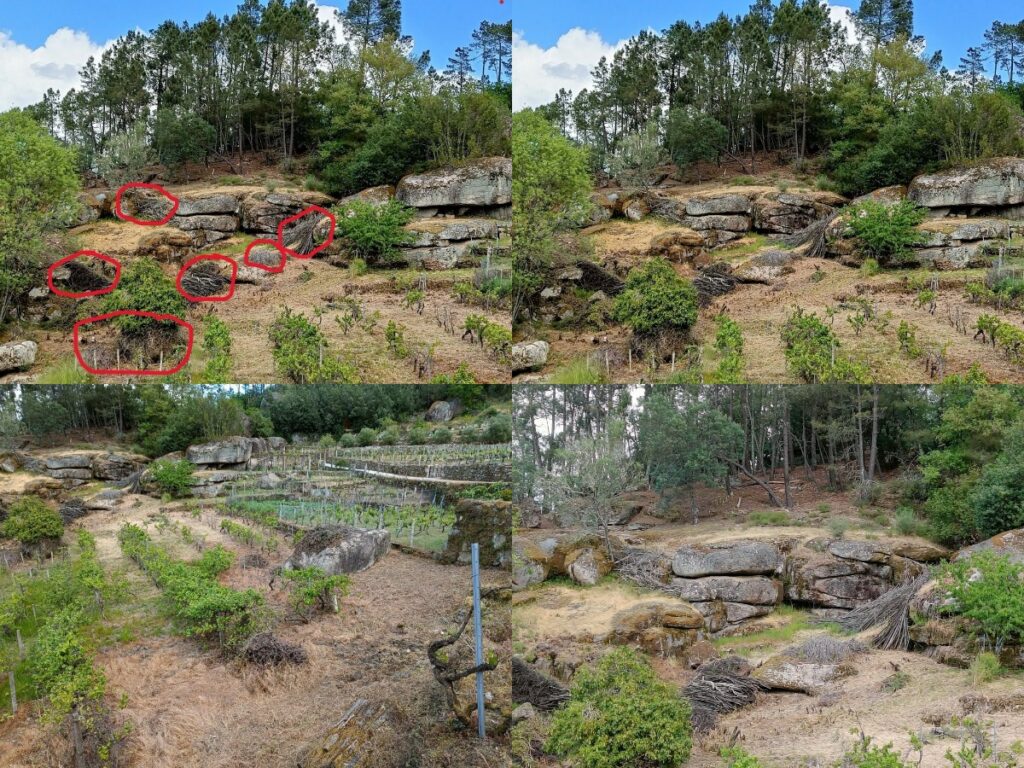
The escalation continued on April 16, when we filed a complaint with the Xunta de Galicia, the Guardia Civil, and the City Council regarding a situation of serious environmental risk: the massive accumulation of vegetation waste, unauthorized tree felling on land not owned by the responsible party, and the possible uncontrolled use of herbicides, creating a real wildfire risk in an area close to homes.
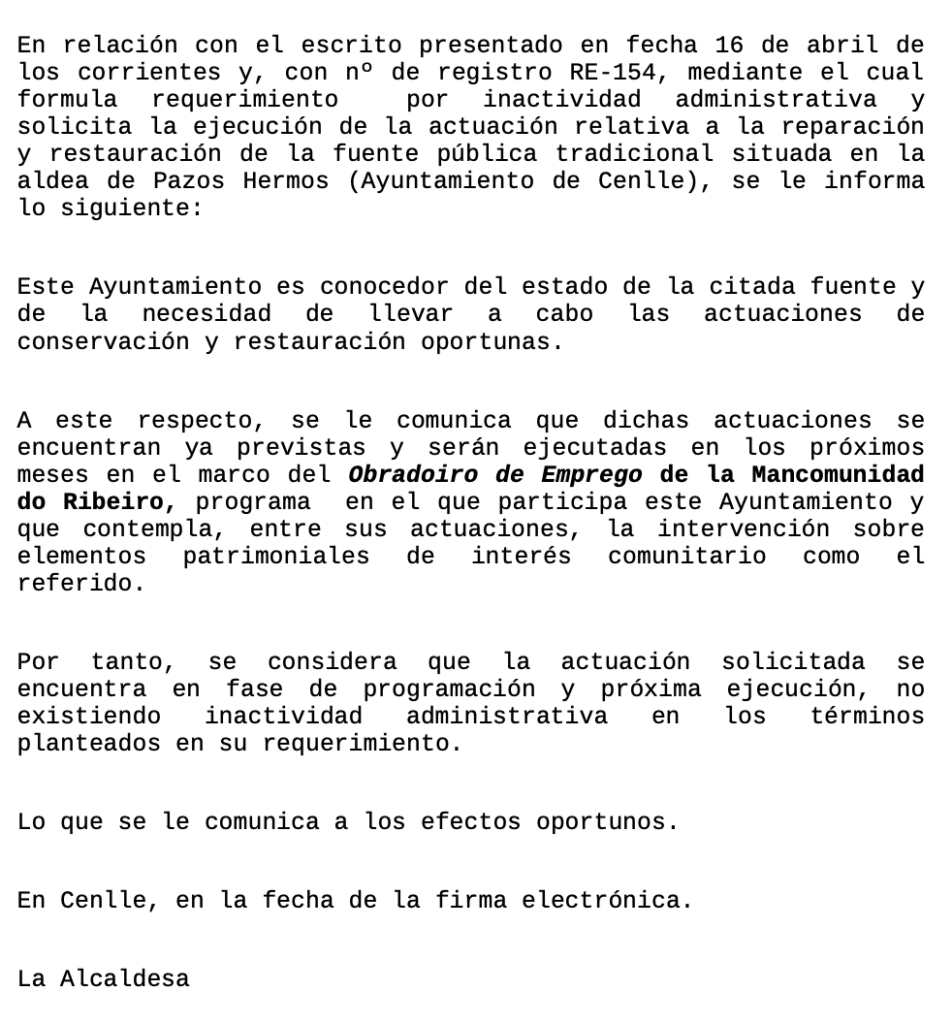
Added to all this is an issue that, far from being resolved, continues to highlight municipal inaction: the heritage fountain of the village. This had already been the subject of a formal complaint in 2025 due to its state of abandonment, and it was later confirmed that the Xunta de Galicia had authorized its reconstruction in September 2024. However, to this day, the intervention has not been carried out, despite the existence of explicit administrative authorization.
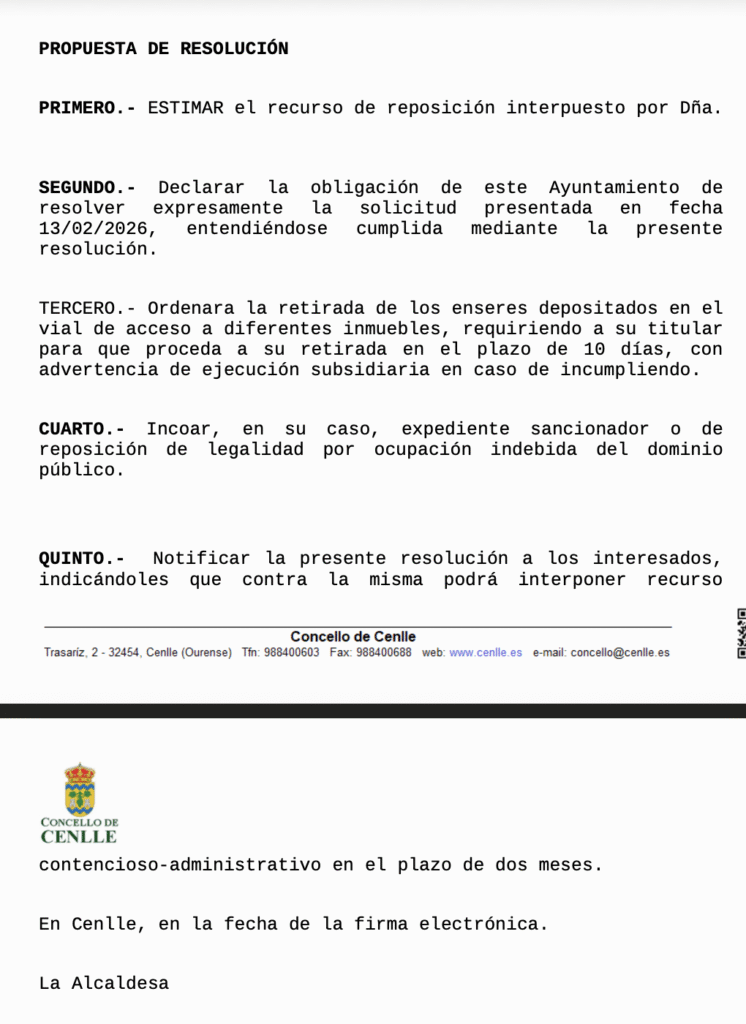
On April 27, 2026, we finally received a response from the Cenlle City Council to two of our complaints. On the one hand, our appeal was upheld and the unlawful occupation of public space was acknowledged, with an order to remove the items within 10 days. On the other hand, the Council acknowledged the deterioration of the traditional fountain and confirmed that its restoration is planned for the coming months.
More articles on the functioning of the Cenlle Town Council: