
Hello everyone,
When we travelled to the United Arab Emirates, our goal was not purely tourism. We wanted to get to know Dubai and Abu Dhabi from a different perspective: to evaluate whether they could be a good place to establish a possible tax residency in the future.
This country has become one of the most popular destinations in the world for entrepreneurs, investors, and international workers seeking very low taxation. For decades there was no personal income tax, and although today there are some indirect taxes, it is still a very attractive tax system compared to Europe.
Currently:
- there is no personal income tax (0%)
- VAT is 5%
- and since 2023 a 9% corporate tax has been introduced
At first glance, this seems like a very interesting situation for anyone looking to optimize their taxation.
But one thing is having tax residency in a country, and quite another is actually wanting to live there. That is why we decided to visit Dubai and Abu Dhabi with the idea of observing how the country really works beyond the tourist image.
From the beginning we were clear about one thing: even if one day we established tax residency there, it would be to spend short periods each year, not to live there permanently.
To maintain tax residency in the United Arab Emirates, it is normally enough to spend around three months per year in the country, depending on the type of visa. Even so, we wanted to see whether the cities would be pleasant places to spend that time.
What factors I consider when evaluating a country to live in
Even before traveling, I already knew that the United Arab Emirates would probably not be a country where I would want to live permanently.
When I think about a place to settle, there are several factors that are fundamental for me:
- Accessible or free public healthcare
- An abolitionist model regarding prostitution
- Gender equality
- Animal protection and welfare
- Safety
- Access to nature
- Air quality
These aspects matter a lot to me because they reflect the kind of society I would like to live in.
How does the United Arab Emirates make money if taxes are so low?
One of the most frequent questions when talking about the United Arab Emirates is how such a wealthy country can maintain such low taxes. Unlike many European countries, in the United Arab Emirates there is no personal income tax, VAT is 5%, and the corporate tax rate is 9% since 2023.
This raises a logical question: where does the money come from to sustain the country’s economy?
The answer is that the country’s economic model is based on several combined sources of income and on a long-term investment strategy that has allowed oil wealth to be transformed into a much more diversified economic system.
Historically, the main source of income for the country has been oil and gas. However, it is important to understand that this wealth is mainly concentrated in the emirate of Abu Dhabi, which holds around 90% of the country’s oil reserves.
For decades, oil revenues financed the construction of infrastructure, roads, ports, airports, and the urban development of cities such as Abu Dhabi and Dubai.
Today, oil still represents approximately 25–30% of the national GDP, but the country has worked intensively to diversify its economy.
A surprising fact is that Dubai has almost no oil. In fact, oil represents less than 1% of Dubai’s economy. This means that the wealth of the city does not come from oil, but from other economic sectors that have been strategically developed over the past decades.
One of the most important economic pillars is international trade and logistics.
Dubai has become a global hub connecting Europe, Asia, and Africa. The Port of Jebel Ali is one of the largest ports in the world and serves as a key point for international trade. In addition, Dubai International Airport is one of the busiest international airports on the planet, turning the city into a major transportation and distribution hub.
Tourism is another fundamental sector of the economy. Every year millions of tourists visit Dubai, attracted by its hotels, shopping malls, international events, beaches, and iconic architecture.
Real estate development also plays a central role in the country’s economy.
Dubai has built some of the most ambitious real estate projects in the world, attracting international investors who buy property as an investment or to obtain residence visas.
One of the most important factors in the economic model of the United Arab Emirates is the existence of sovereign wealth funds. When large oil revenues began to flow, especially in Abu Dhabi, the government decided to invest a significant portion of that money in global investment funds. The most important of these is the Abu Dhabi Investment Authority (ADIA), considered one of the largest sovereign wealth funds in the world.
This fund invests in:
- international companies
- infrastructure
- financial markets
- technology
- real estate
In addition to ADIA, there are other large state investment funds such as Mubadala Investment Company and ADQ, which also invest in projects and companies around the world.
Together, these funds manage more than one trillion dollars in global assets, making the United Arab Emirates one of the largest institutional investors in the world.
Although the country has low personal income taxes, the government generates revenue through:
- 5% VAT
- company licenses
- residence visas
- administrative permits
- property registrations
- government service fees
In other words, the tax system is designed to collect revenue mainly through economic activity, consumption, and services, rather than directly taxing people’s salaries.
First impressions when arriving in Dubai
Our first stop was Dubai. As soon as we left the airport, I thought that I would not want to live there.
There was heavy haze, a smell of smoke, and reduced visibility. During those days I had air quality alerts activated on my phone, and almost every day the same warning appeared: pollution levels considered unhealthy.
Between heavy traffic, constant construction, and desert dust, air quality in Dubai is poor.
In Abu Dhabi, on the other hand, the air seemed somewhat cleaner and the atmosphere more breathable, although there was still some haze.
Urban cleanliness: one of the most impressive aspects
If there was one thing that truly impressed us positively, it was the cleanliness of the cities. Both Dubai and Abu Dhabi have an extraordinary sense of order and urban maintenance. There were always people cleaning.
We even saw people cleaning the tops of trash containers with feather dusters. Maintenance seemed almost continuous.
The contrast was particularly evident for us because we live in Porto, which is a beautiful city, but it has an obvious problem with urban cleanliness, both because of people’s lack of civic responsibility and the lack of maintenance.
That is why arriving in cities where public spaces are so well maintained creates a huge contrast.
Impeccable public restrooms
Another detail that surprised us a lot was the cleanliness of public restrooms.
The bathrooms at the airport were spotless. In all my travels I have only seen something comparable at the airports in Munich and Hong Kong.
The bathrooms were clean, well maintained, and had staff responsible for maintenance permanently. This was also the case in many shopping malls, where the bathrooms looked like those of a luxury hotel.
In addition, there were many free public restrooms in the city, something that is greatly appreciated when traveling, because in many countries, bathrooms end up being another way to take money from tourists.
The honesty of people
Another aspect that caught our attention was the honesty in many everyday interactions.
One of the things that surprises many visitors traveling to the United Arab Emirates is the level of security and the low incidence of common crimes such as theft or scams. In cities like Dubai or Abu Dhabi there is a general sense of safety that contrasts with everyday experience in many large cities around the world.
This perception is not accidental. It is due to a combination of factors: very strict laws, strong institutional control, and a social culture where respect for rules carries significant weight.
According to various international urban safety indices, Dubai often appears among the safest cities in the world in terms of violent crime and theft. This does not mean that crime does not exist, but the incidence is significantly lower.
The criminal system in the United Arab Emirates establishes severe penalties for crimes such as theft, fraud, or scams. Depending on the case, sanctions may include heavy fines, prison sentences, and deportation for foreigners.
For foreign residents, a conviction for certain crimes can imply expulsion from the country after serving the sentence.
This legal framework has a strong deterrent effect.
Another important factor is the level of surveillance. Cities are widely equipped with security cameras in public spaces, transportation systems, and buildings.
In many taxis, for example, there are cameras that record both the driver and the passengers as part of the service’s security system.
In addition to laws, social culture also plays a role. In the United Arab Emirates, there is a strong expectation of respect for rules and authority, something linked both to the political system and the cultural traditions of the country.
A clear example happened to us with a taxi driver in Dubai. We wanted to go to the other side of the Dubai Creek by taxi because we did not have cash for the traditional boat that crosses that route. When the driver understood where we wanted to go, he stopped the taxi and explained that crossing by boat would be much cheaper. He did it simply so we would know the taxi would cost more and not think he was trying to cheat us.
Something similar happened to us in a hotel in Abu Dhabi. After changing rooms, the staff came to ask whether 100 dirhams they had found under the sofa belonged to us. They could easily have kept the money, but they took the time to ask.
These are small details that also shape the experience of a country.
For us, coming from Portugal, which is the country of fraud and scams, we were amazed.
A city full of vegetation in the middle of the desert
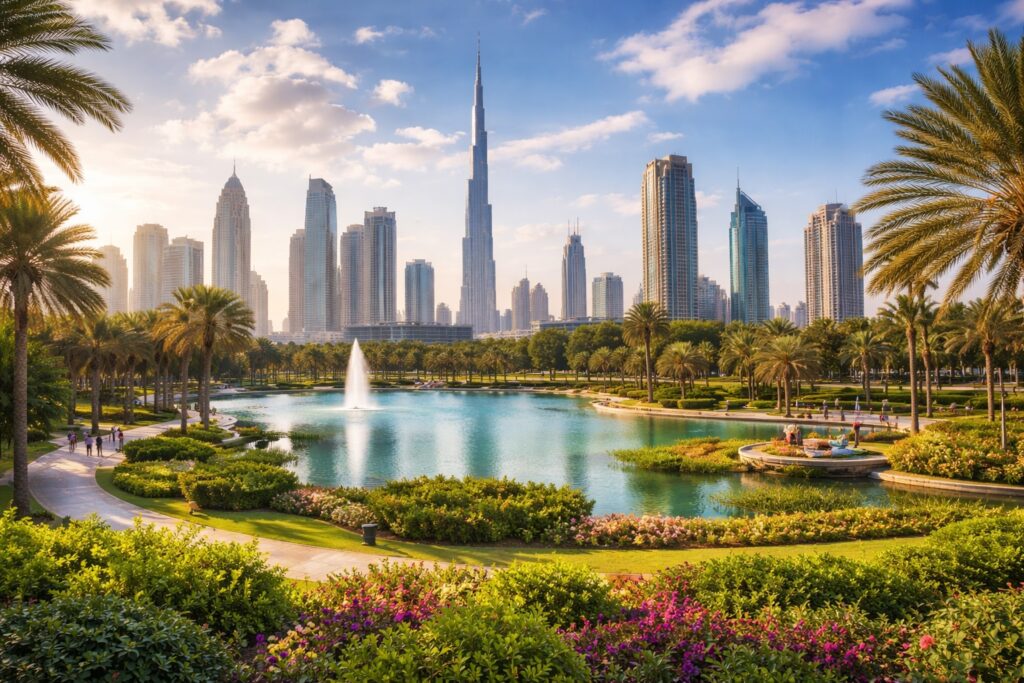
One of the things that most catches attention when visiting Dubai or Abu Dhabi is the enormous number of green areas in cities located in the middle of the desert. Palm-lined avenues, urban parks, perfectly maintained grass, and residential developments surrounded by gardens are part of the usual landscape.
However, behind that image there is a little-known reality: maintaining vegetation in a desert environment requires gigantic infrastructure and very high economic investment.
According to municipal authorities, Dubai maintains more than 10,000 hectares of urban green areas, including public parks, gardens, tree-lined avenues, and landscaped public spaces.
To maintain all this vegetation, the city uses approximately 22 million cubic meters of water per month for urban irrigation. This equals around 264 million cubic meters of water per year in Dubai alone.
Across the United Arab Emirates, water consumption for urban plantations, parks, and forest areas exceeds 700 million cubic meters annually, a huge figure considering that this is a country with a desert climate and natural water scarcity.
The system relies mainly on two sources:
- Desalination plants, which convert seawater into freshwater
- Recycled water from wastewater treatment plants
This treated water is distributed through an extensive network of pipes and automated irrigation systems that allow parks, avenues, and residential areas to be irrigated year-round.
In many cases, drip irrigation systems or night-time irrigation schedules are used to reduce evaporation caused by high temperatures.
Maintaining green areas has become an entire industry in the country. The landscaping and garden maintenance sector in the United Arab Emirates currently moves around 1.6 to 1.8 billion dollars per year, and it is expected to continue growing in the coming decade. In other words, urban vegetation is part of a permanent economic infrastructure.
The government of Dubai continues to actively invest in expanding green spaces. A recent example was a project to plant more than 300,000 trees along roads and avenues, at an approximate cost of 190 million dirhams (about 50 million dollars). These types of projects illustrate how important vegetation is considered within the country’s urban model.
Ultimately, the green landscape seen in many areas of Dubai or Abu Dhabi does not correspond to a natural environment, but to an entirely engineered urban model maintained through technology, energy, and significant financial investment.
Anti-smoking policies
Another aspect that caught our attention during the trip was the presence of many areas where smoking is prohibited, especially on beaches and in public spaces.
On several beaches in Dubai and Abu Dhabi we found clear signs indicating no smoking, which is not accidental but part of the country’s public health policies.
Since 2009, the United Arab Emirates has implemented a federal tobacco control law regulating where people can and cannot smoke. Among other measures, the regulations establish:
- prohibition of smoking in public buildings and enclosed spaces
- restrictions in shopping malls and public transportation
- limitations in beaches, parks, and family areas
- prohibition of smoking in vehicles when minors are present
In addition, the country imposes special taxes on tobacco and strictly regulates its advertising. The stated goal of these policies is to reduce consumption and protect the population from second-hand smoke.
In recent years, some cities have gone further by creating completely smoke-free public areas, especially in tourist or family zones. These initiatives aim to create cleaner and healthier environments and also contribute to the city’s tourist image.
Is it related to religion? In Islam, tobacco consumption is not explicitly prohibited in the Quran, although many religious leaders consider it harmful to health and therefore discourage it. For this reason, in some Muslim cultural contexts smoking may be socially frowned upon, but there is no universal religious ban.
The United Arab Emirates is a country where the majority of the population is foreign, which also influences social habits. In many tourist areas or hotels, it is common to see visitors or expatriates smoking, while in more regulated public spaces tobacco consumption is more limited. For this reason, many travelers feel that smoking is less common in public spaces than in many European cities.
Practical tips for getting around the city
A useful tip for travelers is that it is usually cheaper to take taxis directly from the street rather than using apps such as Bolt. Apps often add an additional commission.
In the next article I will analyze the negative aspects of the country and explain in more detail some social issues that are also important to understand.
I will also share my final conclusion on whether it is really worth living in the United Arab Emirates and establishing tax residency there.
More about the trip to the United Arab Emirates: