
Hi there,
After moving to Porto in September 2022, as I had already been told in Valencia that I had to have a gum graft, I went for consultations with several dentists.
The first one was a clown who was not even a periodontist (although he told me he was) recommended to me by the insurance broker. This misnamed professional told me that I was about to lose several teeth and that I had to get braces again since my bite was a little open. I never went back.
Still, I was traumatized and began to feel uncomfortable with my bite.
I finally went for a consultation with a periodontist that my orthodontist Covadonga Balaguer had recommended. He told me that my bite was not so bad and that one of the hypotheses of gum recession is that the open bite generates more pressure on the teeth that do make contact, but that it was not my case since my gum recession came from brushing and because the lower teeth had been brought forward a lot during the first orthodontics.
I continued to check with the periodontist every 6 months and after two check-ups, I found that my recession was not increasing. So, for the time being gum grafting was optional but not mandatory and the most important thing is that I was not going to lose any teeth.
After 2 visits to the periodontist without my gum recession having increased, I was calmer but then I realized that a tooth had moved. The right central incisor had moved up about a millimeter.
Initially I reconstructed it with composite so that it would not bother me visually and as I continued to feel discomfort with my bite, I decided to get orthodontics again. I decided to go back to my orthodontist in Valencia.
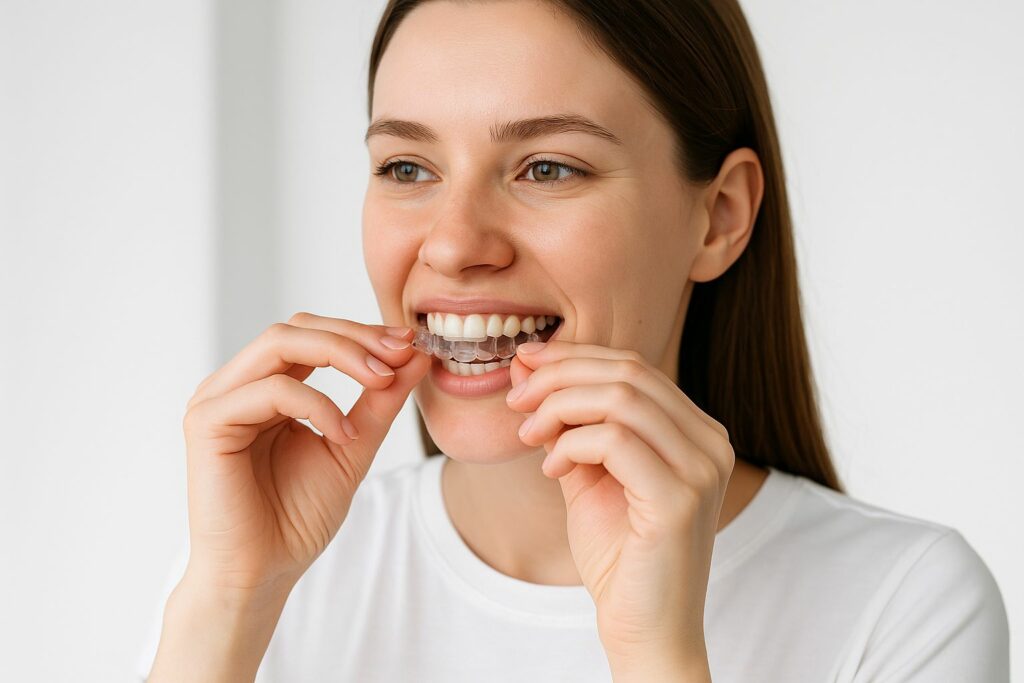
I was clear that I did not want braces as it was going to be my third orthodontic treatment, so I asked for an estimate for Invisalign treatment.
First, they scan your mouth to obtain a 3D image that they send to Invisalign. Then Invisalign sends a treatment proposal that the orthodontist must evaluate and approve. If she does not approve, she must make corrections and send it to them to modify the treatment.
I went for the scan on April 17 and was waiting to meet with the orthodontist and have the treatment explained to me. I imagined that they would call me at the beginning of May, but it was delayed because they had sent 4 proposals to my orthodontist that she did not like, and she had asked for modifications. Finally, I went on June 3 and together we made the final modifications to the treatment.
I was impressed because it was a complex and millimetric procedure. The orthodontist explained to me that I would have several teeth filed down and that I would also have attachments.
I was not expecting this as my idea was not to have to glue anything to the teeth and that is why I did not want to have braces. Even so, Invisalign attachments are smaller than braces.
We had to be very careful with my gum recession and so the bottom teeth were going to move in a way that was expected to improve the recession.
Normally, the attachments are put on the third aligner so that the patient can get used to wearing the aligners. As I live in Porto, we agreed that they would put the attachments from the first aligner so that I would not be obliged to return to Valencia the following month.
I was offered the comprehensive model because this way I would have unlimited aligners for 3 years. The other models have a limited number of aligners, and my orthodontist said it was better this way to be covered.
On July 4th I went again to Valencia to get the aligners. It was a 1h30 appointment in which they put 9 upper and 6 lower attachments. In addition, they polished the teeth, especially the lower ones, because with Invisalign the teeth must be well separated for the treatment to take effect.
When they were filing the upper teeth, I began to regret having chosen Invisalign. I asked the orthodontist if I would have had to file my teeth if I chose braces and she told me no, that the biomechanics of the aligners were different.
I was given 12 aligners out of 22. The first 2 I would wear for 15 days each and thereafter, one week each.
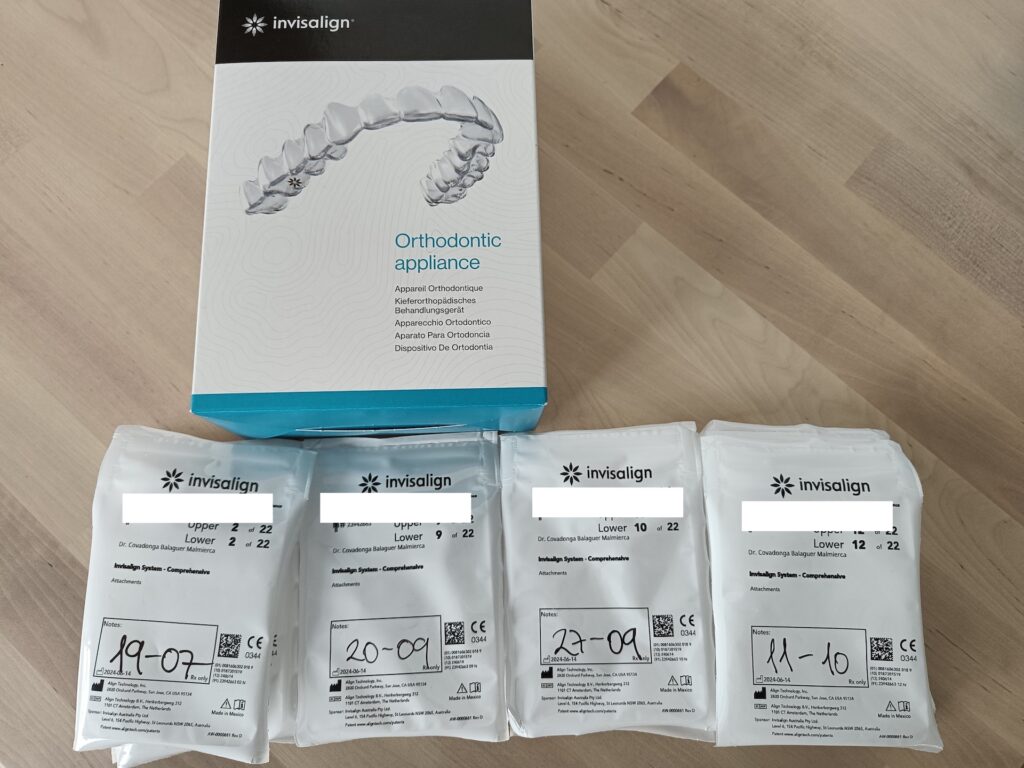
Since it is mandatory to wear the aligners minimum 20 hours a day, you must eat fast and run to brush your teeth to put them back. I was told that with this treatment dental hygiene is vital because even a little tartar can make the treatment not work.
As I was not going to be in Valencia, they gave me access to an application called “virtual care” so that I could upload the photos of my teeth every time I changed aligners.
The first 2 days with the aligners were difficult because I was stressed about taking the aligners out and having to eat quickly to run to brush my teeth.
Then, photos with the app also seemed like mission impossible because there was no way the app would accept them. In the end, I started using the light ring and the situation got better.
On October 17, I went for another consultation in Valencia. Although I felt my teeth looked practically the same, the orthodontist told me that I was doing very well.
They put 8 more attachments on my molars and I felt like Frankenstein; there I thought it was almost better to have chosen braces. Putting the rubber bands on the attachments the first day was traumatic and my mouth was sore. Then it got better and better.
On December 12 was the next consultation. As I had two aligners left, 15 days of treatment, we made the appointment before finishing to make the images of the mouth in 3D and try to have the following aligners without wasting time.
I talked to Covadonga because the right side of the mouth was almost perfect, and the left side was still bad. We did tests and the whole left side was open; she polished several teeth that were rubbing and preventing the aligners from working properly.
Here I think it is very important to emphasize that the doctor, when she saw the images of the supposed final result in the Invisalign program, said that “that was a lie”. This means that it is very likely that things will have to be adjusted, and your teeth will not be perfect with the first set of aligners. In addition, there are factors that can affect the proper functioning of your aligners that Invisalign will most likely not be able to foresee.
Since we were in the last half of December, we would see if it was possible to have the second batch of aligners before the 15 days were up. On January 3, 2025, I went to consultation again. They put more attachments, so I had practically no more space left in my teeth for them to stick anything on.
They had made 13 more aligners, of which I was given 11. As the last 2 had the function of retainers, we would make the appointment at the end of aligner number 11, to see if anything else needed to be adjusted in the orthodontics.
In other words, the new appointment would be in almost 3 months, so it was already 9 months of treatment.
On March 21 I returned to Valencia. As the result was still not what expected, I had my teeth scanned again and they removed the 4 metal attachments from my molars; at least I had that relief.
While I was having the dental cleaning, I was told that a composite had fallen out of my lower central incisor. As it was late in the afternoon, I could not find a dentist in Valencia to fix it. The following Monday, I called CEPI to see if Tiago, who had done another of my composites in Porto, could see me urgently and it turned out that the earliest he could see me was April 10th.
Since I was going to Amsterdam the first week of April, I looked for another dentist who could see me sooner, big mistake. I ended up going to the office of the sister of a CrossFit teammate. The first thing she told me was that I had a lot of mobility in my lower teeth and that’s why I had gum recession. As I have told you in other posts, I have had gum recession for many years.
She told me that she could not guarantee that the composite would last long because of the mobility of the teeth (which has nothing to do with it). In addition to being traumatized until the next appointment with my orthodontist, the composite fell out after 3 days, so I still had to go to CEPI on April 10 and go on a trip with the gap in my tooth.
During the trip, one night, after brushing, I saw that one of my teeth had moved more than usual and I got very scared, so I wrote to my orthodontist and told her that I was not going to put the lower aligners back in until she saw me again. Within a week, those teeth were no longer moving.
Since I only had 3 aligners left, on April 15 I went back to Valencia to get the third set. Covadonga explained how I could loosen the aligner a little if it felt too tight. I was given 11 aligners and would finish this third round on July 1, 2025. There died my hopes of leaving for the Iceland trip in June with my teeth already perfect.
At the end of May, I contacted the clinic again because the two lower central incisors were once again slightly loose. It was only a little, but even so, it was necessary to be cautious.
They told me to extend the treatment period per aligner to 10 days, or even 12 if necessary, so by July 8, it was clear that the treatment would not be completed.
On July 8th, they did a new scan of my mouth, and I spoke again with the orthodontist, who explained that, in reality, only about 60% of Invisalign’s planning is fulfilled. The problem was that I only had one set of aligners left.
Even if you pay for Invisalign’s Comprehensive plan, which supposedly offers unlimited aligners, in reality, it’s only four sets. If after those four sets your teeth still aren’t as they should be, you have to pay extra.
So, in my case, I only had that fourth and final set left. I went back to Valencia on July 30th —I took a same-day round-trip flight— so they could give me those last aligners.
They gave me 16 aligners, which really surprised me, because my teeth were already looking so good and I was so close to reaching perfection in terms of both functionality and aesthetics, that I didn’t expect to still have 16 more weeks of treatment ahead. It felt like the orthodontic process would never end.
When I started this fourth set, I realized that I still wasn’t seeing the progress I had expected. I got in touch with the orthodontist because, even though the treatment was officially supposed to end on November 19th, I already suspected that by that date I would still be in the same situation. It’s true that my mouth had changed a lot, but I still needed to close my bite properly and align the upper central incisors with the canines —something that remained unresolved.
It’s also worth mentioning something here: Invisalign is great for people who can’t go to the clinic frequently, since the monitoring is done through the app, but that app isn’t actually very useful. There’s no way to compare the photos you upload with the original treatment plan images, so until you finish a full set, you really don’t know if the treatment is working as it should or how much progress you’ve actually made.
On October 24, I went back to Valencia. I had already been noticing that something wasn’t quite right: my teeth were moving in ways they shouldn’t, and the bite on the left side was opening — exactly the opposite of what was supposed to happen. She confirmed that the bite on the left side was indeed opening because two molars were making very strong contact, which was affecting the proper functioning of the aligners.
She also explained that the treatment would probably not be finished by November 19, which I had already suspected. During this appointment, they placed three buttons on the molars on the left side so I could use elastics and apply more pressure to help close the bite on that side.
On November 19 I went back to the appointment, and they again performed the intraoral scan, the photographs, and all the usual tests. I spoke once more with the orthodontist, who explained to me that there was very little left to finish closing the bite (that “very little” was already taking us more than a year and a half).
So, I was waiting for them to notify me when the new aligners were ready in order to go back to Valencia again. This, in a way, also ruined my December a bit, because I had to waste time traveling once more. I was already so exhausted from the entire orthodontic process that each day I had to go to Valencia and spend a night there I felt like I was losing five years of my life.
On December 15, after the usual cleaning, the doctor polished my left molars because it was necessary to make room. The new set had 18 aligners, of which I was given 8, and we agreed to return in a month to check that the treatment was progressing well.
I had an appointment in January and, in between, I traveled to the United Arab Emirates. After returning, I continued with the treatment, and my next important check-up took place after my trip to Denver, Colorado, on May 27.
During those months, I had one constant concern: that I would need another set of aligners. I had already gone through one refinement phase, and I knew that if another set was needed, it would not only extend my orthodontic treatment even further but would also mean an additional cost.
The only tooth that continued to resist was my upper left central incisor. We had spent many months trying to move it down a little further so it would line up perfectly with the right one, but it simply wouldn’t move. After discussing it with my orthodontist, we decided not to prolong the treatment for another six months over such a tiny difference.
Besides, I had already decided that once my orthodontic treatment was finished, I wanted to have both upper central incisors rebuilt with composite to make them slightly longer. So that minimal height difference would eventually be corrected with the cosmetic treatment anyway.
Even so, I went to my appointment on May 27 convinced that they would tell me we still weren’t finished. I kept noticing small details that, in my opinion, showed that my teeth hadn’t quite reached where they were supposed to be.
To my surprise, my orthodontist told me that we were indeed finishing the treatment that day. She explained that the small space that remained on the right side would close naturally as my bite settled and that the final results of orthodontic treatment become visible over the following three to four months. To help this process, she performed a slight adjustment on one of my molars so my teeth would have the space they needed to settle into their final position.
That appointment was probably the longest and most exhausting of the entire treatment. I spent between four and five hours at the clinic. First, all of my attachments were removed using different dental burs, and the sensitivity I felt was awful. Afterwards, I had a professional cleaning and a full polish. Then, my fixed retainers were placed, and just when I thought everything was finally over, they still needed to make that small adjustment on my molar before taking the 3D digital scan to manufacture my clear retainers.
When I left the clinic, I had a headache after spending so many hours with my mouth open while my teeth were constantly being polished and adjusted. At the same time, I felt an enormous sense of relief I had finally completed my third orthodontic treatment. From that point on, all that remained was the cosmetic part I had always planned: rebuilding my two upper central incisors with composite for better aethetic results.
After going through three orthodontic treatments, I think one of the most important things I have learned is that Invisalign is not exactly what many people imagine before they start.
I chose it because I didn’t want anything bonded to my teeth again. After my previous two treatments with braces, I remembered perfectly how sensitive my teeth became every time a bracket was removed. In some teeth, that discomfort could last for weeks or even months, so I thought Invisalign would allow me to avoid that.
The reality was different. Although I wasn’t wearing braces, I still had numerous attachments bonded to my teeth throughout almost the entire treatment. In fact, on some molars I had two or even three attachments on the same tooth, so in that respect, the difference compared to traditional braces was much smaller than I had expected.
That doesn’t mean Invisalign has no advantages. For me, the biggest one is the level of independence it gives you. If everything is progressing well and you already have several sets of aligners, you don’t need to keep going back to your orthodontist for adjustments like you do with braces. This is especially convenient if you travel frequently or have a busy schedule.
It also makes oral hygiene much easier because you can simply remove the aligners to brush your teeth normally. However, that advantage also comes with a downside: you have to eat quickly and then rush to brush your teeth before putting the aligners back in.
Invisalign significantly affected my daily life. For almost two years, I practically stopped eating out because it was exhausting to always carry a toothbrush with me and have to brush my teeth in restaurant bathrooms.
There is also another aspect that very few people talk about and that I think is important to know before starting treatment. Invisalign markets the Comprehensive plan as an “unlimited” treatment, but it isn’t actually unlimited.
The Comprehensive plan includes four rounds of aligners. It’s true that within each of those rounds, they can manufacture as many aligners as necessary for that phase, but once those four rounds have been used, any additional refinements have to be paid for separately. In my case, that’s exactly what happened, and I had to pay for an extra round.
The treatment doesn’t really end on the day your aligners are removed. Throughout all those months, your teeth have been moving under the guidance of the plastic aligners, and they still need time to settle naturally. In fact, my orthodontist explained that the final result isn’t visible until approximately three or four months after the treatment ends, once the bite has fully settled.
As for the technology, Invisalign has an app that, in theory, allows you to take regular photos so your orthodontist can monitor your progress remotely.
Honestly, I found the app completely useless. Getting it to accept a photo was incredibly frustrating. It required almost professional lighting conditions, it often failed to focus properly on my teeth, and even when it finally accepted an image, it frequently uploaded it completely blurred.
I ended up doing something much simpler: sending the photos directly to my orthodontist via WhatsApp or email.
Another detail worth mentioning is that the aligners stain easily. It doesn’t matter if you don’t drink coffee, wine, or any other staining beverages, or if your oral hygiene is impeccable. As the days go by, the plastic gradually turns yellow.
Another important thing to keep in mind is that only about 60% of what Invisalign plans actually ends up happening, so the treatment simulation shown in the software isn’t a realistic prediction of the final result.
In the end, after completing the entire treatment, I don’t think it’s fair to say that Invisalign is better than braces, or vice versa. They are simply different treatments, each with its own advantages and disadvantages. Not every tooth movement can be achieved equally well with aligners. There are cases where Invisalign works extremely well, while in others, traditional braces may be a more effective or faster solution. That is something your orthodontist should always determine based on your individual case.
I also believe the choice depends a lot on your lifestyle. If you value not having to visit your orthodontist constantly, Invisalign offers much greater flexibility because you can have several sets of aligners in advance and space out your appointments. On the other hand, braces give you the advantage of not having to remove anything every time you eat or worry about carrying a toothbrush everywhere you go.
In my case, living in Portugal while my orthodontist was based in Valencia made Invisalign probably the most practical option. It allowed me to travel for appointments every two or three months instead of having to fly every month for the regular adjustments that braces require, saving me both time and money.
More articles on teeth and orthodontic treatments: