
Hello everyone,
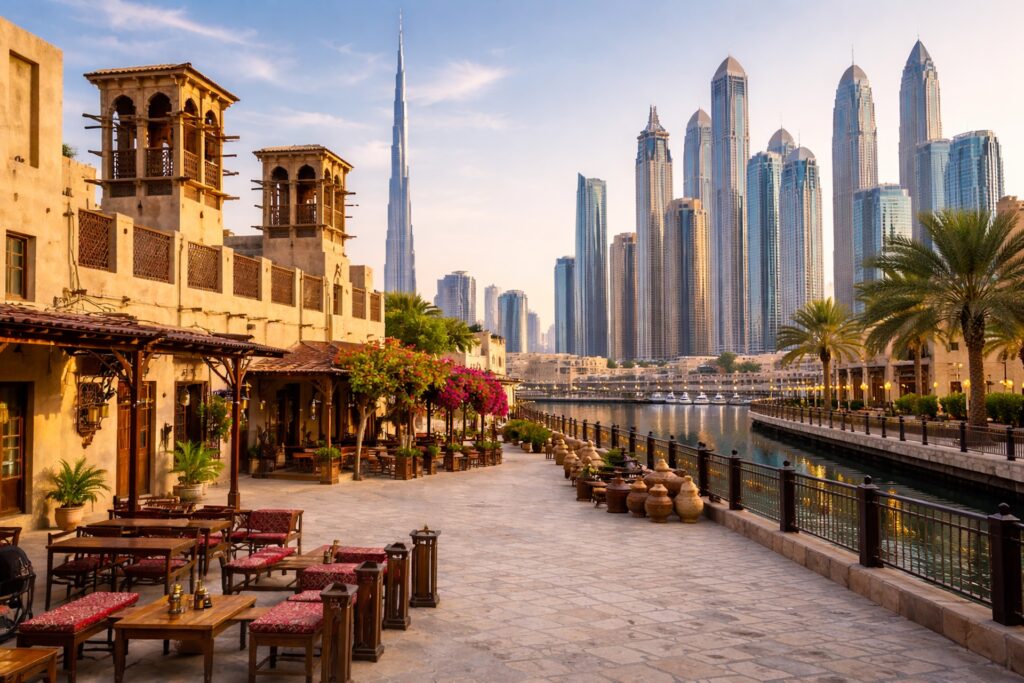
To understand Dubai, you first have to understand where this city comes from.
Until the mid-20th century, Dubai was nothing more than a small settlement located next to the Dubai Creek, inhabited mainly by fishermen, merchants and pearl divers. For centuries, the local economy depended on fishing, maritime trade and the pearl industry, which was one of the main sources of wealth across the Gulf region.
At the beginning of the 19th century the territory came under the rule of the Al Maktoum family, which continues to lead the emirate today. For a long time, Dubai was simply a small commercial port, a trading point between Persia, India and the Arabian Peninsula.
The decisive change came in 1966 with the discovery of oil. Although the emirate’s reserves were never as large as those of neighboring territories, the income made it possible to start a very rapid urban and economic transformation. Roads, ports, airports and free zones were built, while the city positioned itself as an international center for trade, tourism and services.
In just a few decades, what had once been a coastal village surrounded by desert became one of the most modern cities in the world, filled with skyscrapers, giant highways and urban projects designed to break architectural records.
This transformation also presents a paradox. Dubai is a city built in an extremely harsh natural environment, where temperatures exceed 40 °C for much of the year. This means that much of urban life depends on artificial systems: permanent air conditioning, intensive irrigation to maintain green areas and enormous energy consumption to sustain infrastructure and buildings.
For this reason, many visitors feel that Dubai has a particular atmosphere: a futuristic city built in the middle of the desert, where almost everything has had to be created from scratch and where almost everything is artificial.
During our stay in the city, we visited several of the most well-known areas. This was our itinerary:
February 22
- Al Shindagha Museum
- Grand Souk – Bur Dubai
- Al Fahidi Historical Neighbourhood
- Walk along the Dubai Creek
- Dubai Gold Souk
February 23
- Dubai Opera
- Burj Park
- Dubai Fountain
- Boulevard Walk
February 24
- Jumeirah Mosque
- La Mer
- City Walk
February 25
- Dubai Marina Walk
- Bluewaters Island
We arrived at Dubai International Airport, and the first thing that caught our attention was how impeccable everything was. The airport is enormous, modern and very clean.
Another thing that surprised us was the number of children traveling on the flight. It’s not the kind of destination one usually imagines filled with families with small children, but the plane was almost full.
The “historic Dubai” – Al Shindagha and Al Fahidi
Our first stop was the area of the Al Shindagha Museum and the Al Fahidi Historical Neighbourhood.
This area aims to show what Dubai was like before the oil boom, with traditional houses, narrow alleys and the well-known wind towers, a passive ventilation system historically used to cool homes in extremely hot climates.
The Al Fahidi neighborhood — formerly called Al Bastakiya — does have a real historical origin. It was built at the end of the 19th century, around 1890, when Persian merchants from the city of Bastak, in present-day Iran, settled near the Dubai Creek to take advantage of maritime trade in the region. At its peak it had around sixty traditional houses.
However, as the city grew many of these homes were abandoned or demolished, and the neighborhood was even close to disappearing in the 1980s. Eventually it was decided to preserve what remained and restore the area as a historic and cultural district, which explains why today it combines some original houses with more recent reconstructions.
For this reason, when walking through the area the feeling can be different from visiting a completely authentic historic neighborhood. Much of this district now functions as a tourism-oriented reconstruction, designed to show what traditional Gulf homes were like.
The original houses in the region were usually built with mud, coral or bajareque, materials adapted to the desert climate. In contrast, many of the buildings seen today are made of cement designed to imitate those materials, which sometimes gives the complex an appearance closer to a historical set than to a fully preserved old neighborhood.
Another interesting element is the wind towers, known as barjeel. Although today they are strongly associated with the traditional architecture of Dubai, they are not originally Emirati. This ventilation system comes from Persian architecture and was introduced to the area by Iranian merchants who settled in the neighborhood at the end of the 19th century.
These towers function as a natural cooling system: they capture air currents at higher levels and channel them inside the houses, helping to cool the rooms before the invention of air conditioning. This type of architecture was used in several regions of the Gulf and southern Iran, adapting to extreme climate conditions.
Overall, visiting Al Fahidi helps to understand what life in Dubai was like before the rapid modernization of the emirate, even though today the neighborhood combines real history with restorations and reconstructions designed to preserve that urban memory.
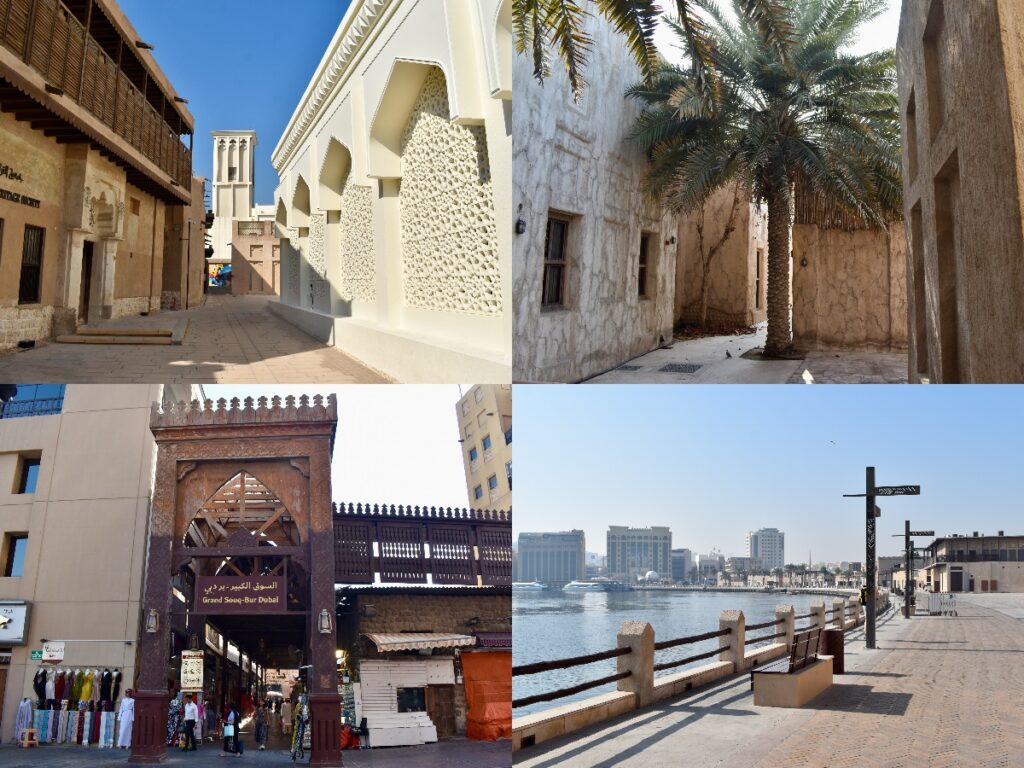
Walk along the Dubai Creek
The promenade that runs along the Dubai Creek is pleasant for walking and observing the contrast between old Dubai and modern Dubai. Interestingly, there is no bike lane, something surprising in a city with so much urban infrastructure.
When we visited there were very few people because it was Ramadan, so the streets were quiet.
One thing that surprised us was that, despite the extremely high level of cleanliness visible in many areas of the city, there was still trash along the edges of the creek.
The traditional souks
We also visited some of the most well-known markets, such as the Dubai Gold Souk and the Grand Souk.
Here the atmosphere changes completely compared to ultra-modern Dubai. These markets resemble much more what one expects to find in many cities in the Arab world: streets full of small shops, merchants and market stalls.
Prices are also more normal than in many modern areas of Dubai, where everything tends to be expensive.
Downtown Dubai
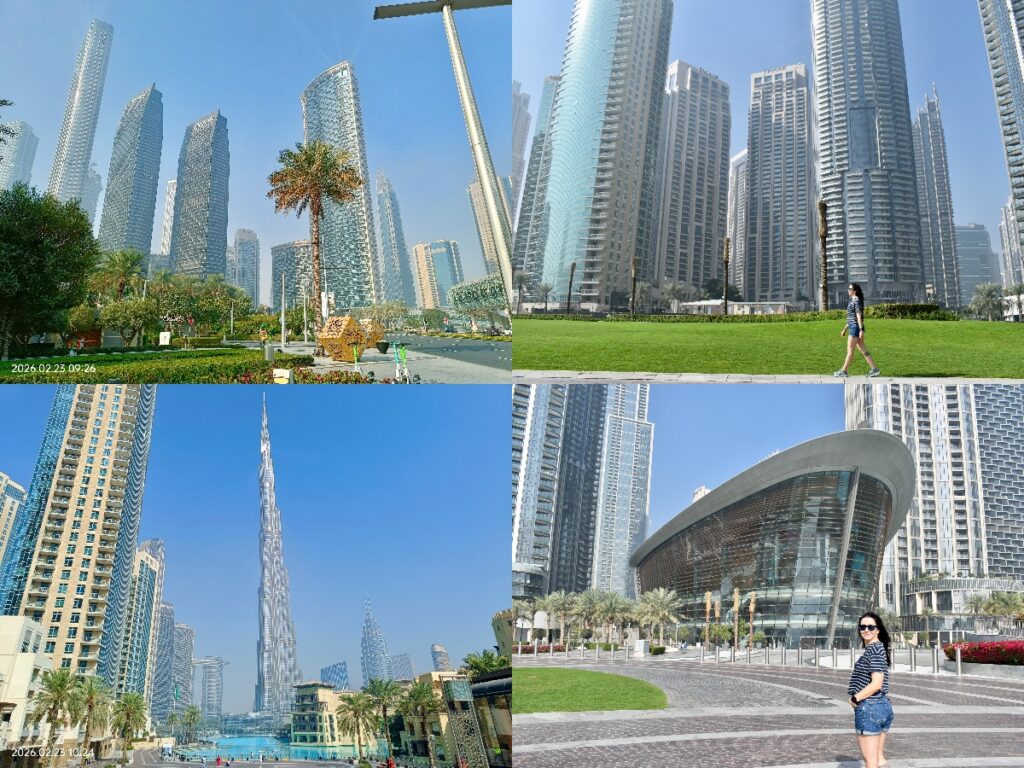
This is one of the most famous and photographed areas of the city. Some of the most recognizable symbols of Dubai are located here, such as the Burj Khalifa, the tallest skyscraper in the world, as well as the large artificial lake where the Dubai Fountain shows take place.
Architecturally, the place is impressive. Everything is designed to make an impact: wide avenues, massive buildings and a skyline that has become one of the most iconic images of the city.
However, when walking through the area, the feeling is that everything revolves around large buildings and shopping malls. Beyond the visual impact of the architecture, urban life is mainly concentrated in the Dubai Mall, one of the largest shopping malls in the world.
We also walked through Burj Park and along Sheikh Mohammed bin Rashid Boulevard, an avenue surrounded by restaurants and hotels with views of the Burj Khalifa.
The skyscraper is truly impressive when seen from below. Going up to the observation deck was one of the options, but we finally decided not to do it. Tickets usually cost between 65 and 150 euros, depending on the level and the visiting time.
In addition, during the days we were in the city there was heavy dust haze, with completely gray skies and very poor visibility. Under those conditions paying that price to go up and not see the landscape didn’t make much sense.
Jumeirah
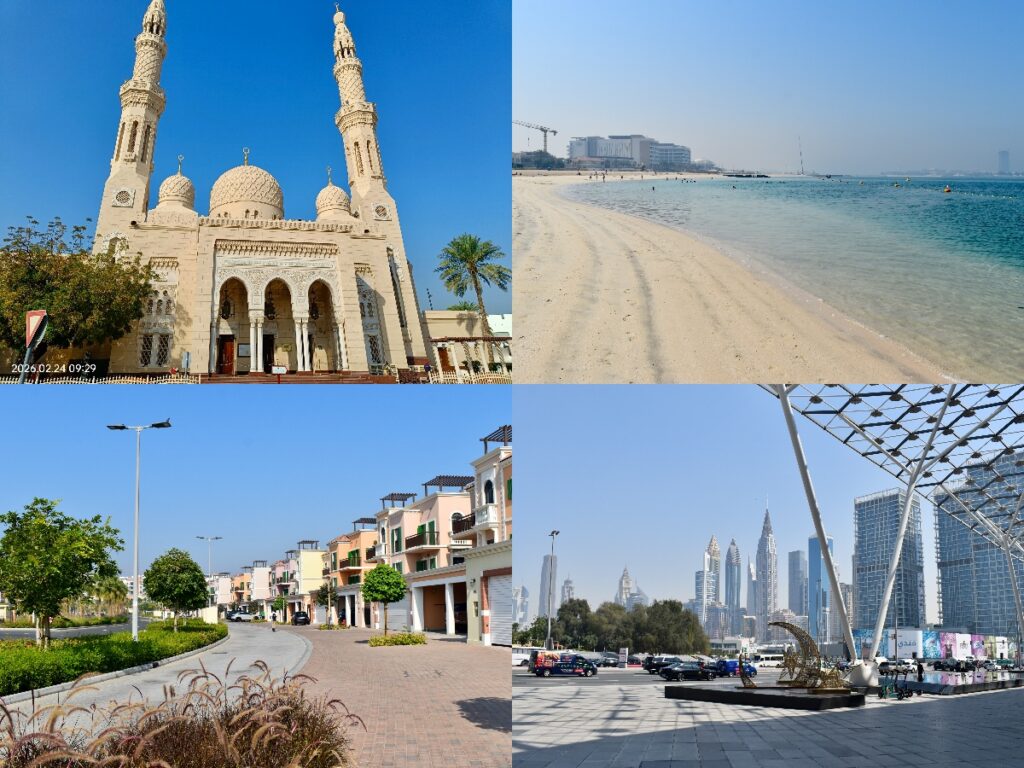
The Jumeirah Mosque, one of the most famous mosques in the city. When we arrived it was closed, so we could only see it from the outside. The architecture is beautiful, with a classic Islamic style.
However, the atmosphere around it felt somewhat artificial. There were camels placed outside so tourists could take photos, something we personally didn’t like. I am not a supporter of animal tourism or those types of practices, so we took a quick photo and continued our route.
Later we visited La Mer, a beach area with restaurants, cafés and a seaside promenade.
It is a pleasant place to walk by the sea, although it is not particularly remarkable. In addition, something that repeats itself in many areas of the city is that Dubai is constantly under construction. Even on the beach you could hear machinery and nearby building works, which made the environment less relaxing than expected.
The area basically consists of restaurants, beach clubs and privatized beaches.
We also visited City Walk. This place is presented as a modern urban district, but in practice it functions as a large open-air shopping mall.
Dubai Marina
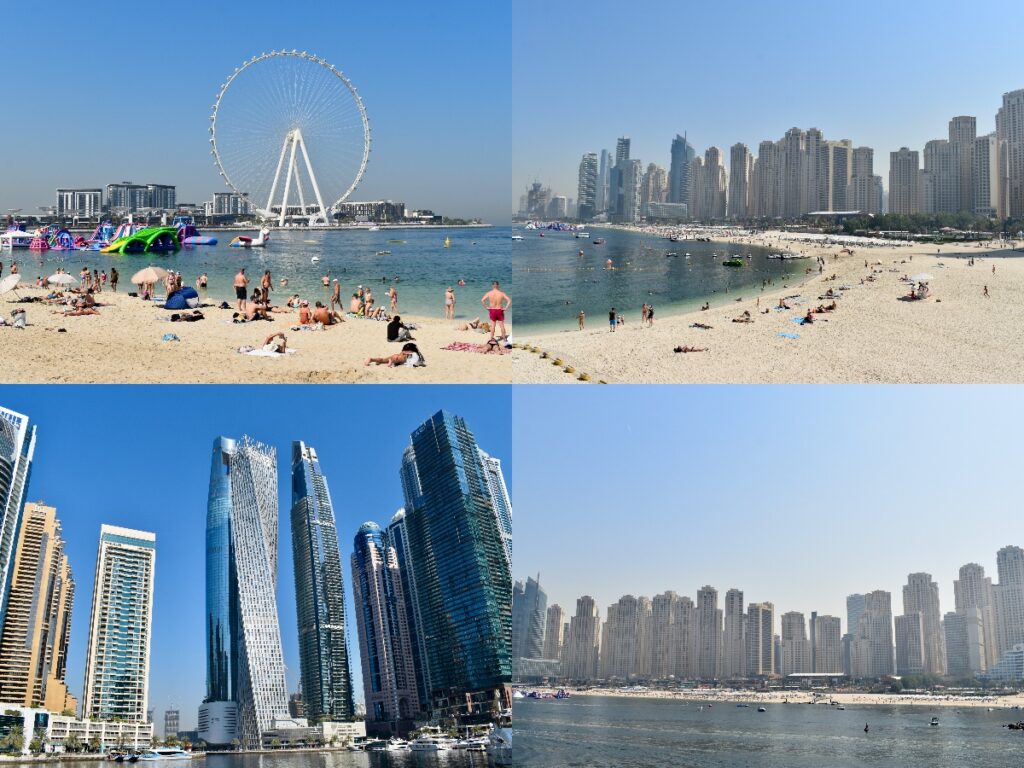
We also visited the area of Dubai Marina, where the promenade known as Marina Walk is located.
Here there is more space to walk, and we also found a bike lane, something we had not seen in other parts of the city. The promenade surrounds an artificial canal and is surrounded by skyscrapers and restaurants.
However, as happens in much of Dubai, the environment is completely artificial. The canal, the marina and the urban development were built from scratch.
We also passed through Bluewaters Island, an artificial island where the large observation wheel Ain Dubai is located.
The place follows the same model as many other areas of the city: essentially another large shopping mall.
General impression of Dubai
After several days exploring the city, the impression we were left with is that Dubai is visually impressive, especially because of its architecture and the scale of its buildings.
Many attractions are designed to break records or attract attention: the tallest building, the largest observation wheel, the biggest frame in the world, the largest shopping mall in the world, etc. In many cases they simply become places to take a photo and move on.
Another impression that repeats itself during the visit is that much of urban life revolves around shopping malls. In many places what you find are shops, restaurants and spaces designed for consumption.
From our point of view, Dubai can be visited in a couple of days. It is not a destination with a large cultural or natural offer, so exploring the city can be done relatively quickly.
We usually went out in the morning for a few hours to visit some place and then spent the rest of the day relaxing at the hotel.
As a city to live in, at least for the lifestyle we are looking for, it didn’t fit us. It is a city designed mainly to move around by car, where walking or having an outdoor lifestyle is not easy.
There are also no options for hiking or nature activities. Dubai may be attractive for those who enjoy restaurants, shopping malls and urban entertainment, but beyond that the offer is limited.
Here is the link to my YouTube channel:
More about the trip to the United Arab Emirates: