
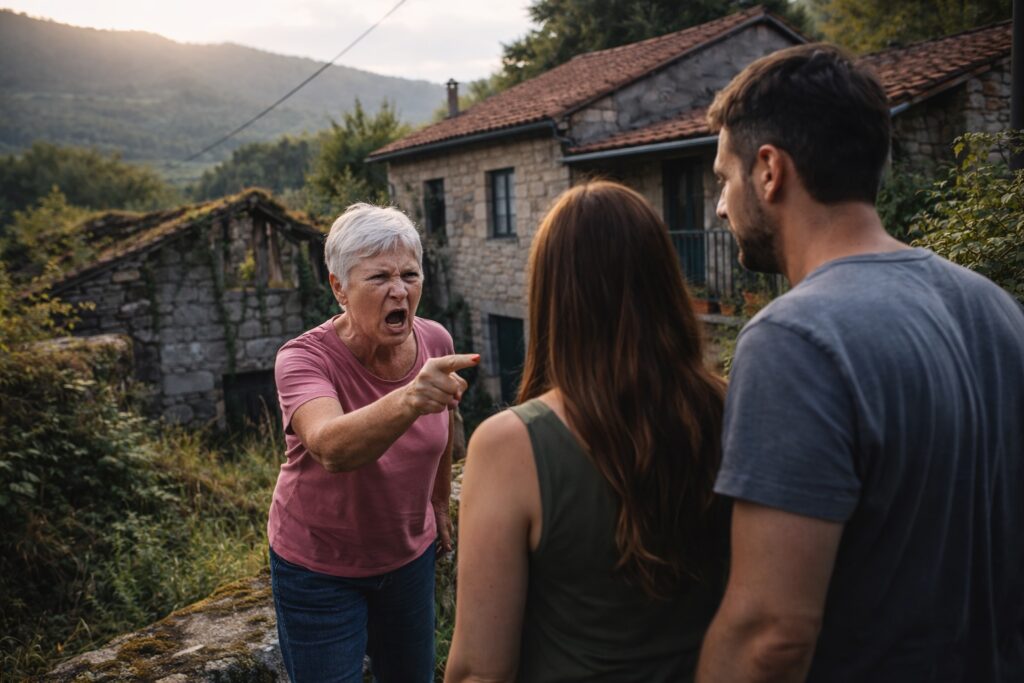
On May 16, our neighbor Margarita began telling us that the dampness in her house was caused by one of our properties, a ruin that we had purchased in April along with the house. Not only that, but she filed a complaint with the Cenlle City Council and sent Sergio registered letters with nonsensical accusations.
Here is the first part of this post:
In those letters, she demanded that he be forced to build a new house from scratch, saying that the ruin was full of rats, that there was a risk of fire, that weeds were spreading everywhere; in short, a list of exaggerations and lies that made no sense. Because it is clear that no one can force another person to build a house from scratch for their comfort.
The curious thing is that Margarita claimed to have had damp problems for “many years,” but she had never complained about anything until just after our purchase. And even stranger: if you really have a problem that affects the structure and safety of your house, the logical thing to do is to fix it first and then complain. But in her case, it was all excuses, changes of story, and accusations against whoever suited her at the time.
From May to August, Margarita always had a different story. One day the complaint was against Sergio and Susana, then the following weekend it was against us. At first, she said she had an expert report, then it turned out she never had one. In fact, the City Council itself denied the existence of such a report.
By the beginning of August, we were exhausted. Every time she saw us, she would keep us talking nonsense for over an hour, while we had a thousand things to do at home. So, we decided to set a limit: we asked our lawyer to send her a formal letter stating that any future complaints about dampness must be addressed directly to him.
That’s when everything changed. Margarita went from being the “friendliest” person in the world to not speaking to us. Her kindness was just a facade to try to manipulate us and get what she wanted.
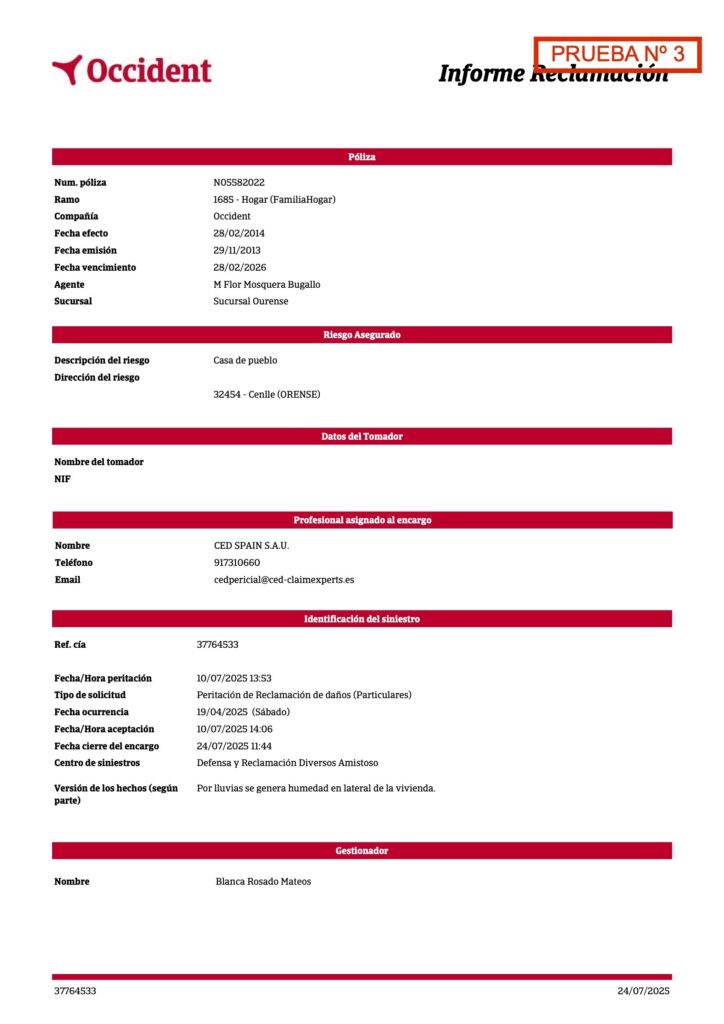
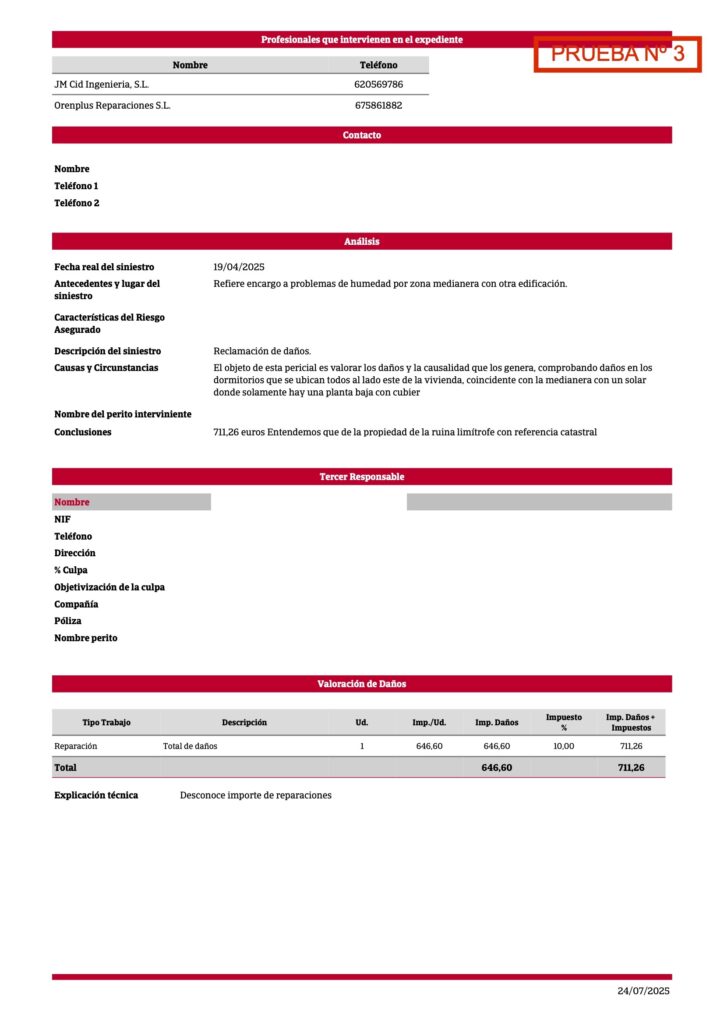
The most surreal part came later: we received a document from their insurance company, Occident, entitled “Claim Report”. The document said absolutely nothing. It only stated that “the owner of the house” claimed that the dampness came from our ruin. No evidence, no technical explanation, no real expert opinion, no basis whatsoever.
That document also included photos of the inside of Margarita’s house. And that’s when I was really shocked: the deplorable state of the house was incredible. Dust had accumulated as if it hadn’t been cleaned in 50 years, there were cobwebs everywhere, and it was filthy and totally unsanitary. It looked like one of those abandoned houses you see in horror movies. I did community service in Venezuela and visited houses in extremely poor neighborhoods, and none of them were in such bad condition.
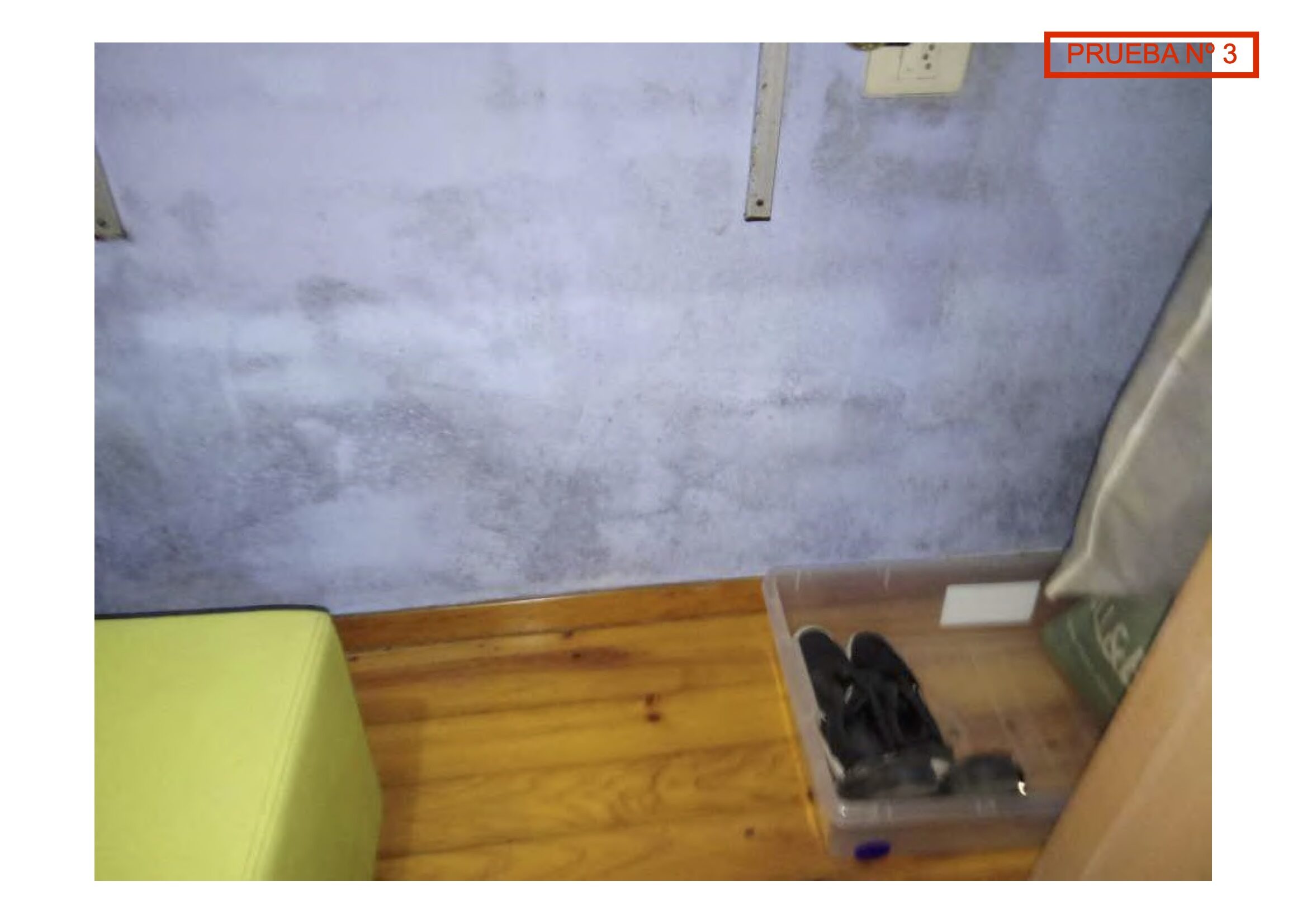
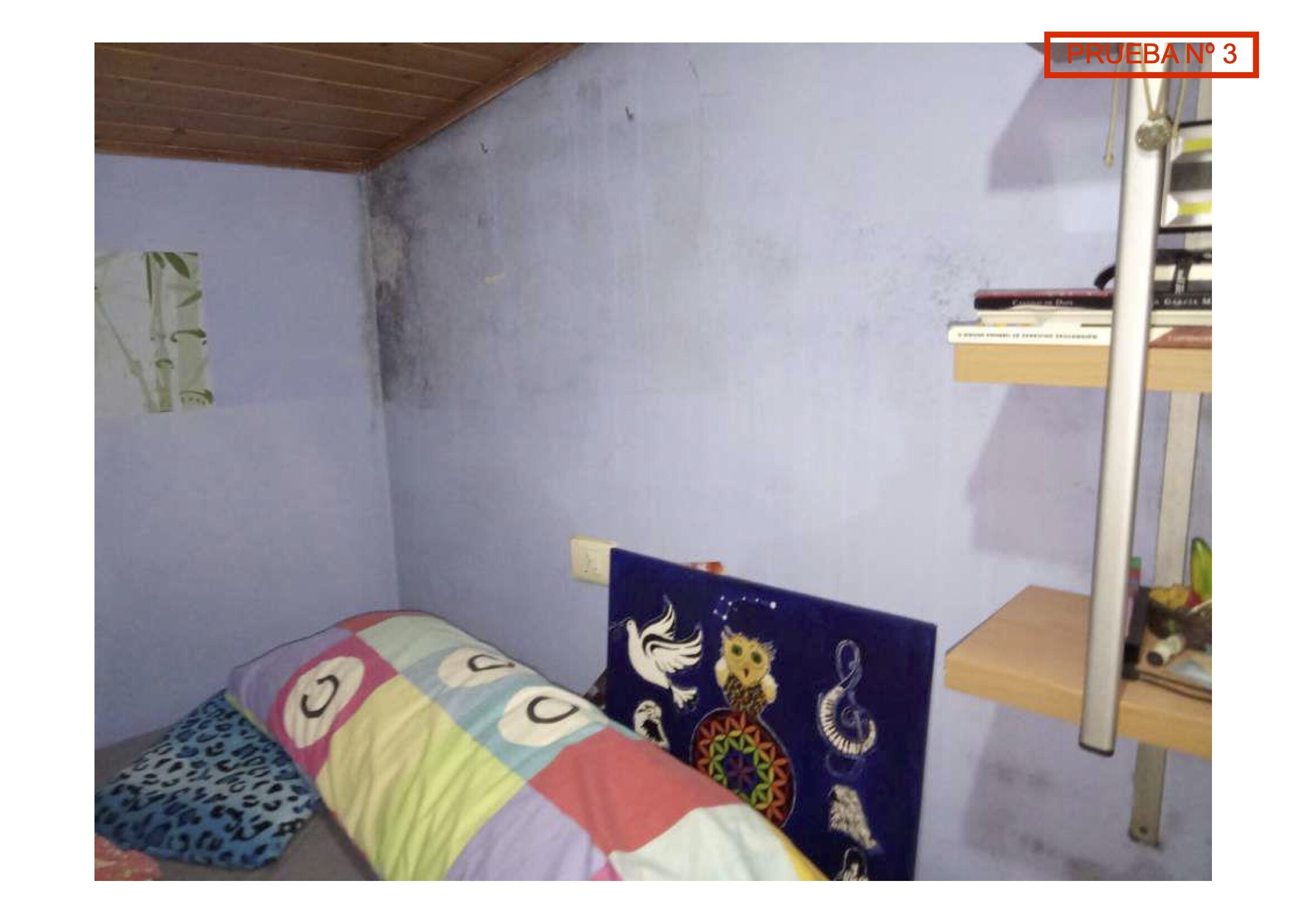
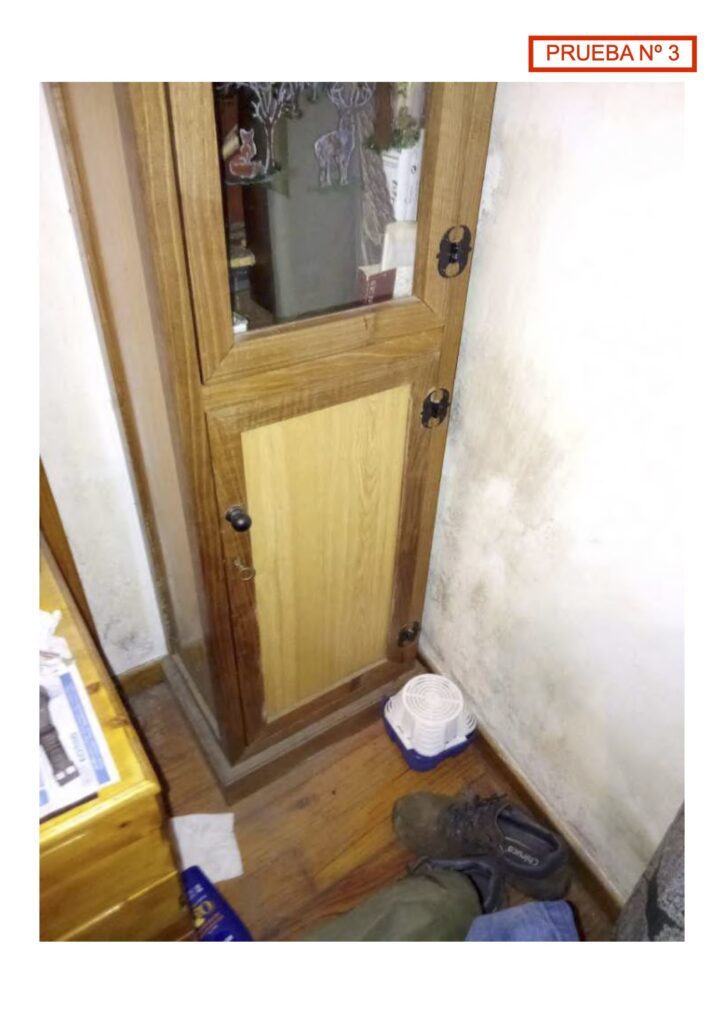
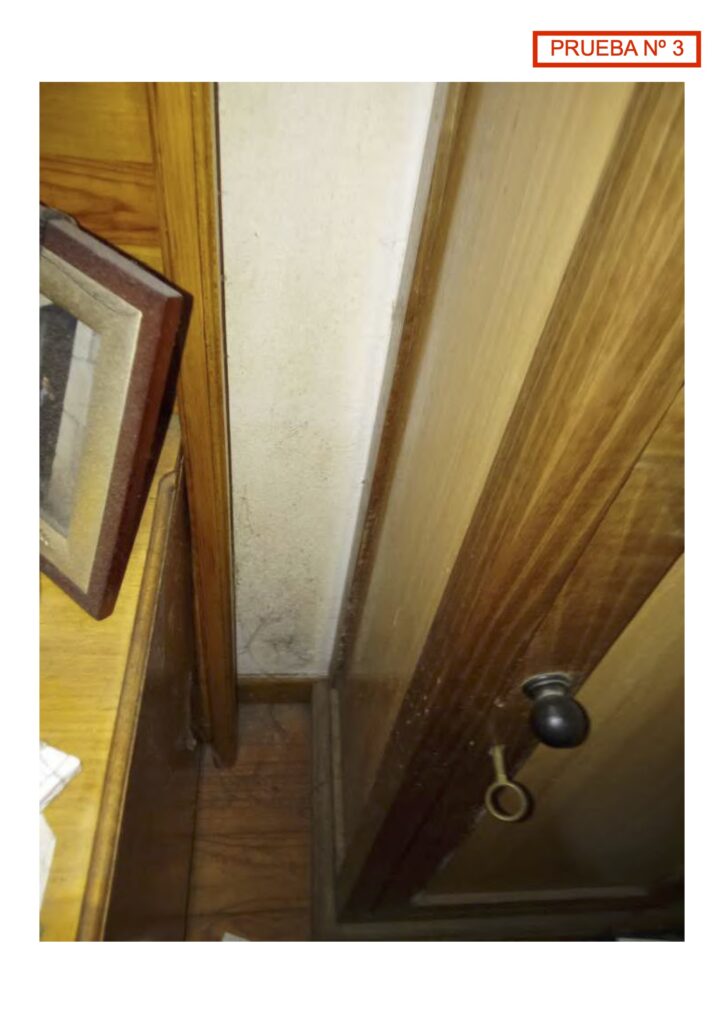
With these photos, it became even clearer that the real problem was inside Margarita’s own house, not in our ruin.
In addition, this alleged claim report mentioned an amount of 712 euros. We thought that was the amount she was claiming, so we talked to Sergio and Susana, and they agreed to pay her that amount. However, there was one condition: Margarita had to put in writing that she would never make any further claims, either against the former owners, us, or future owners.
Margarita refused. She said that the €712 was what she had to pay her insurance company and that it was our responsibility to carry out the necessary repairs to stop the damp coming in. According to her, she wanted a new roof, the wall waterproofed, and a section of ironing. The strange thing is that none of this was specified in the alleged report. They were simply personal demands, without any technical backing.
There we were back to square one: what repairs actually needed to be done? That should be determined by a serious expert report. Such a document should rule out problems with capillary action, damp foundations, or even internal condensation in her home. And if, in the end, we were to blame for the damage, it would have to explain why and to what extent.
In addition, a technical report must clearly state the measures to be taken. If a roof needs to be installed, it should say so; if waterproofing is required, it should be put in writing. But this document said nothing.
On August 28, 2025, we spoke to our lawyer again and made it clear: we did not accept that document as an expert report. The right thing to do was to request the actual report, with technical and legal grounds.
Also, Margarita had to commit to never make another claim in the future. Otherwise, this would become a never-ending claim: every time she had a problem in her house, she would come and hold us responsible. And I am convinced that all this stems from a structural problem in her home, which no repair work on my property would solve.
During our trip to Scotland, the lawyer informed us that Margarita had called him again to ask when we were going to resolve her alleged problem.
Since the document sent by her insurance company was not an expert report, the lawyer told us that we could propose to Margarita that we pay half of the cost of an expert report.
The former owners told us they were not willing to pay anything, and I didn’t think it made sense to pay half of an expert report either. If she is the one making the claim, she should pay for the expert report to prove she is right.
So, on October 3, I informed my lawyer that we were not willing to pay half of an expert report and that he should give Margarita one last chance to deliver the document. If she did not deliver it, we would close the case, and she could file whatever complaint she wanted.
When we returned to the house in Ourense on October 11, 2025, we found two letters from Margarita’s insurance company. In both, they threatened to take legal action if the claimed amount was not paid.
We were in shock. As I had already mentioned before, Margarita had clearly said that she didn’t want the 712 euros, that she herself would pay that amount to the insurance company, as she did every year, and that what she wanted was for the multiple repairs of the ruin she had been complaining about for so long to be carried out. So, it made no sense at all to now receive these threatening letters. I imagine there has been a huge communication failure between Occident and the owners of the house, because it seems that no one really knows what is going on.
On the other hand, we also couldn’t understand how Occident had sent letters directly to our address, when from the very beginning it had been made clear that all communications had to be conducted solely and exclusively through our legal representative.
So, on October 13 I contacted my lawyer to explain the situation. I told him that, first, we had to stop communicating with Margarita, since she was neither the policyholder nor the insurer.
Since Margarita had no direct legal relationship with the insurance contract and, moreover, her behavior up to that point had been erratic and contradictory, we agreed with the lawyer that from then on, all communications should be strictly limited to the insurance company.
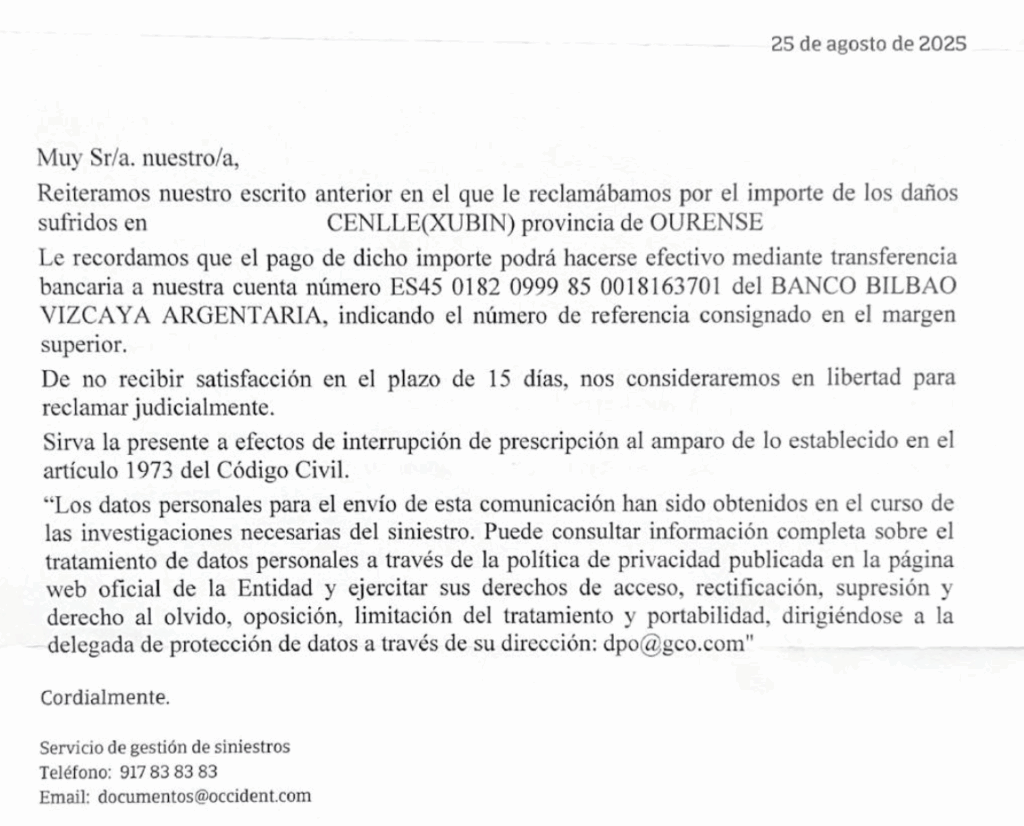
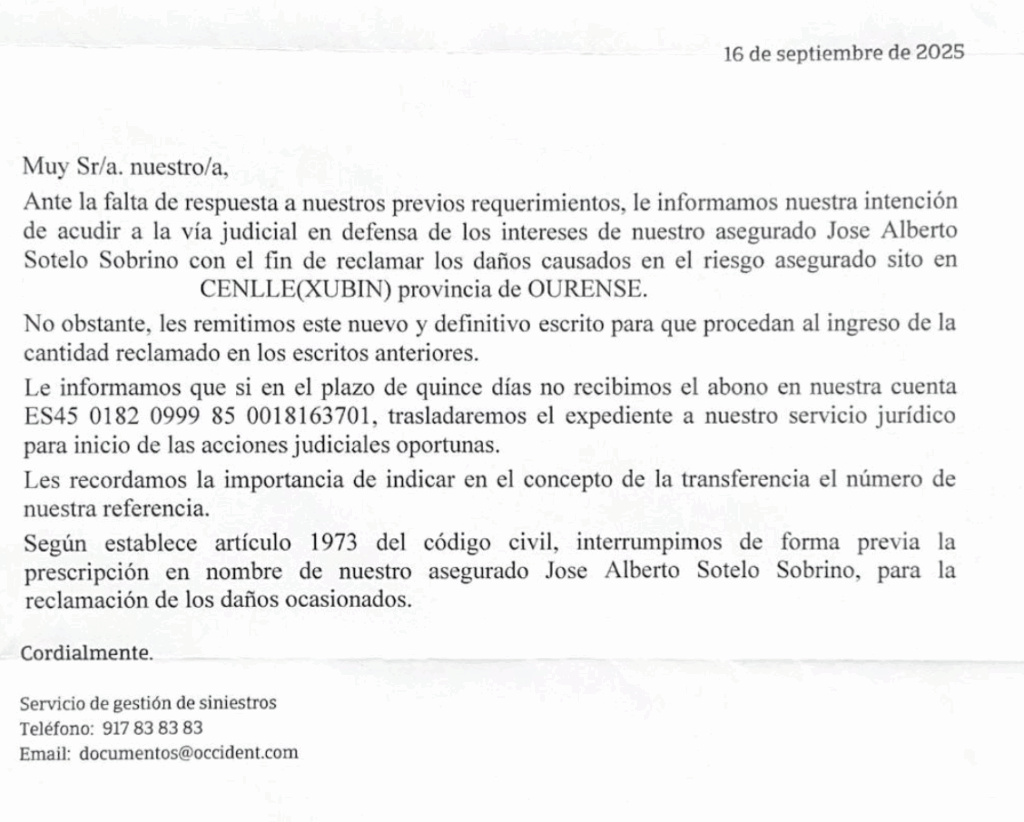
On the first weekend of November, we returned to the house and once again found letters from Occident. Tired of this harassment and considering that there was no technical evidence holding us responsible and that the Town Council had even ruled out any risk, we decided to file a complaint with the Directorate-General for Insurance for malpractice and for pressuring a third party unrelated to the policy without any legal basis.
That same day, we also filed a second complaint with the Spanish Data Protection Agency, since we had never authorized the insurance company to process our personal data or to send letters to our home. We are not clients of Occident, nor is there any contractual relationship with them, so the use of our address to send notifications was completely irregular.
On November 13, our lawyer sent us a “new expert report” that he had received from the insurance company. This report was a document with the same content, but formatted to look more formal, although it was still not a valid expert report.
We sent another letter to the DGSFP informing them of the irregularities that continued to persist in the document and in the actions of this insurance company.
At the end of November, we received a response from the Directorate-General for Insurance and Pension Funds (DGSFP). In it, we were informed that, before being able to file a formal complaint with this body, we first had to contact the insurance company’s customer service department and wait for the legally established period of one month. If, after that time, the response was unsatisfactory — or if we simply did not receive any response at all — then we would be able to initiate the procedure before the DGSFP.
We decided to go to the Guardia Civil to seek advice on the possible legal avenues. There, we were told that, for the time being, the facts did not fall under criminal law, as the letters we had received were not considered harassment in legal terms, but rather a matter of a civil nature.
This placed us in a complicated position. Turning to the civil courts would, in practice, mean seeking compensation for the damages suffered. However, at that moment there was no quantifiable economic harm.
For all these reasons, we chose to wait. We decided to await the response from the Spanish Data Protection Agency and to see how the complaint filed with the insurance company’s customer service department would evolve.
At the end of December 2025, we stopped receiving any further letters containing threats or requests for money transfers. We then understood that this complaint may have served to correct the irregular practice that this insurer was carrying out.
My personal impression is that Margarita may have had the collaboration of someone she knew within the local office of the insurance company in an attempt to push forward a claim that was clearly irregular and without legal basis. In any case, the fact is that the complaint was effective: they stopped sending letters to our home in Ourense. Margarita also did not contact our lawyer again.
Everything indicated that the matter was, at least for the time being, on hold.
More articles on searching for and buying our second home: